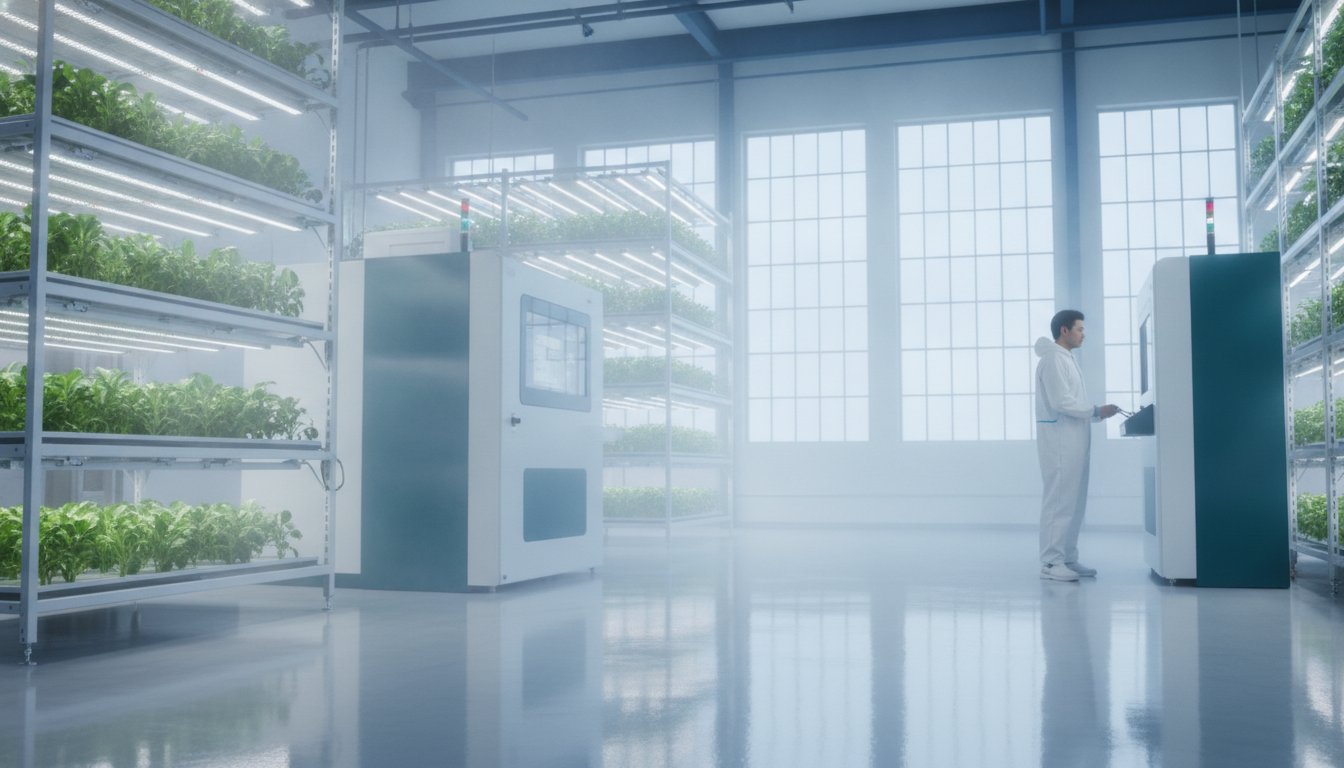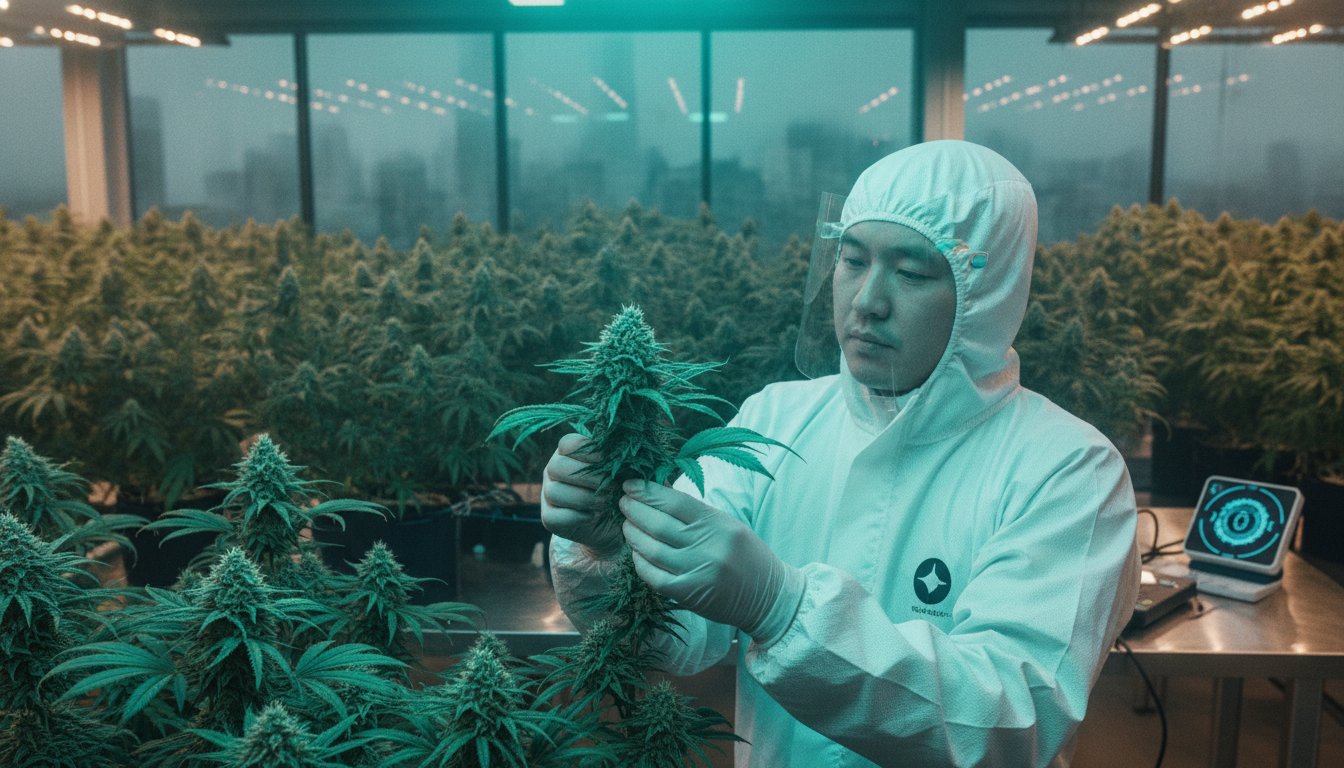
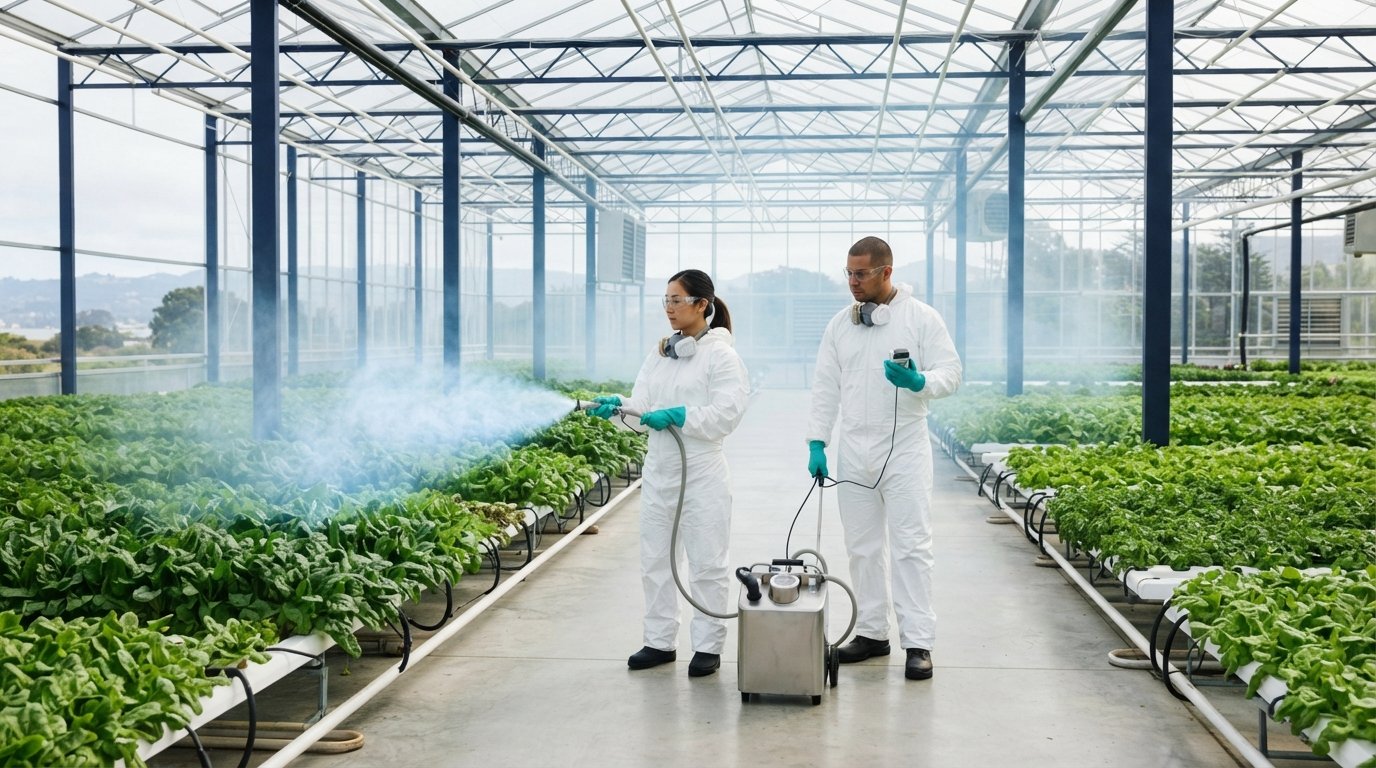
What if the fungicides you rely on to protect your canopy are quietly threatening your harvest and your bottom line? In commercial cultivation, finding an effective protocol for mold remediation for greenhouses often feels like an impossible trade-off between fighting recurring outbreaks of Botrytis or Powdery Mildew and avoiding chemical residues that trigger strict compliance testing failures.
You already know that commercial growing spaces, especially in damp coastal climates, create the exact microclimates where stubborn fungal pathogens thrive. Traditional chemical sprays and heavy-handed scrub downs rarely solve the core issue; they merely drive spores deeper into hard-to-reach ductwork, structural trusses, and microscopic crevices while risking product quality. You shouldn't have to choose between a clean facility and clean, compliant crops.
In this guide, you will discover how to eliminate systemic contamination throughout your entire facility using non-invasive, science-backed remediation methods that leave zero toxic chemical residues. We'll examine the biology of greenhouse mold, outline the physics of whole-facility decontamination, and detail the testing protocols required to protect your yield, pass microbial screening, and safeguard your operation's ROI.
Key Takeaways
- Understand why effective mold remediation for greenhouses requires treating the entire facility envelope, structural voids, and airflow channels rather than relying on surface sprays.
- Evaluate the practical limits and contamination hazards of conventional liquid fungicides compared to modern, non-invasive remediation methods.
- Discover how sub-micron Dry Fog technology penetrates hidden structural nooks and ductwork without wetting equipment or causing costly demolition downtime.
- Learn the essential phases of an objective remediation workflow, starting with baseline air quality testing and concluding with laboratory verification.
- Review the specific climate management techniques and microbial compliance standards necessary to run a resilient commercial cultivation facility in coastal California.
Why Greenhouse Mold Remediation is a Systemic Necessity
Surface-level plant management is not structural decontamination. Commercial cultivation teams often treat powdery mildew or bud rot as isolated agronomic issues, spraying foliar treatments directly onto the crop canopy. Professional mold remediation for greenhouses targets a completely different operational vector: the total elimination of active fungal colonies and ambient spore reservoirs embedded within the building envelope itself.
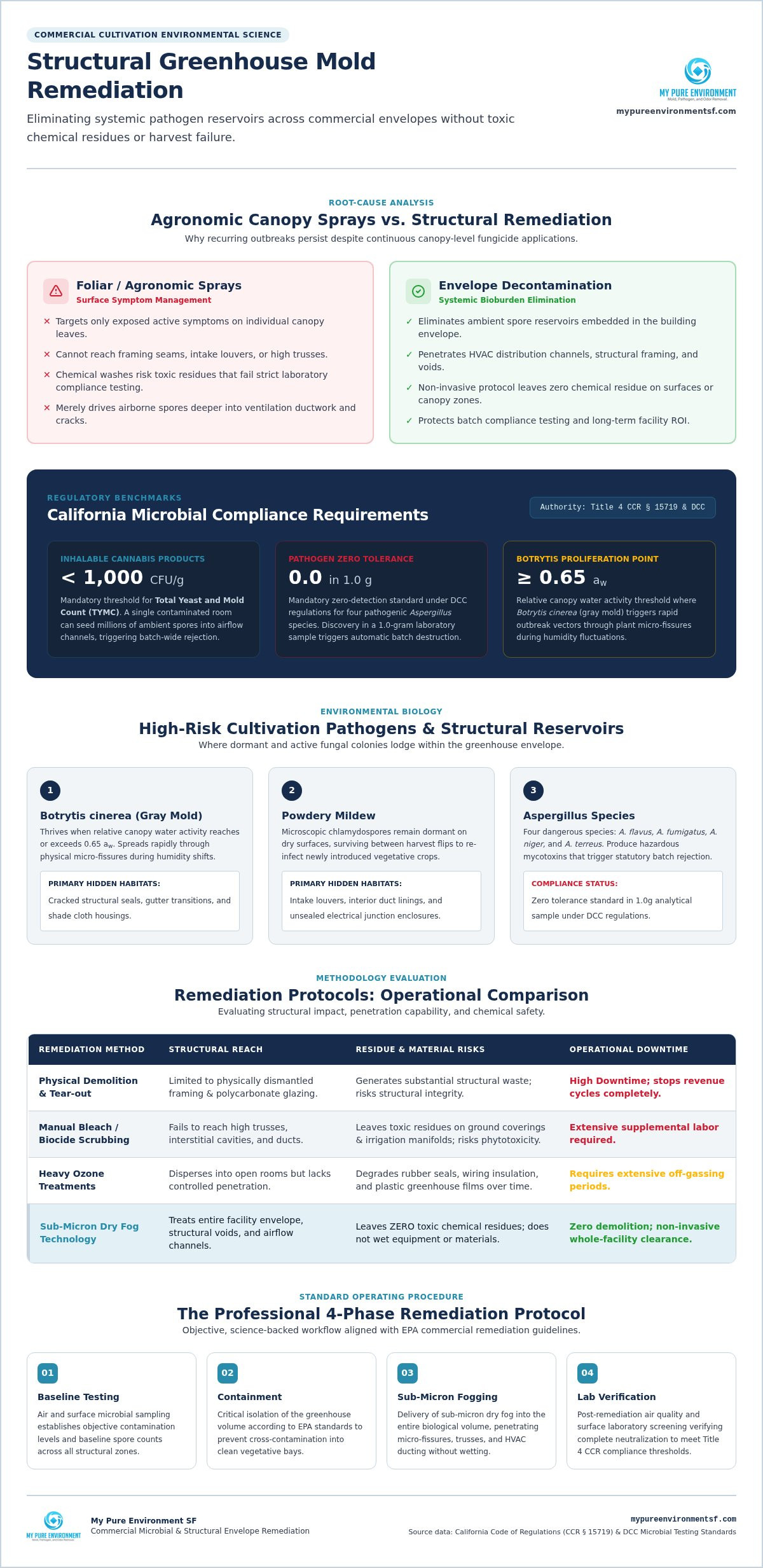
While agronomic sprays address active symptoms on individual leaves, structural mold resides inside HVAC distribution channels, framing seams, and porous insulation. Traditional liquid fungicides simply cannot resolve these environmental reservoirs. In regulated sectors like commercial cannabis, relying on plant washes leads to disastrous economic consequences. Under California Code of Regulations Title 4 CCR § 15719, inhalable products face a strict Total Yeast and Mold Count threshold of less than 1,000 CFU/g, alongside zero tolerance for specific pathogenic contaminants. A single contaminated room can seed millions of microscopic spores into the airflow, causing batch-wide laboratory failures and total crop destruction.
The ROI of Structural Purity
When fungal reservoirs colonize the cultivation structure, every newly loaded crop enters an actively compromised ecosystem. Recurring crop loss quietly drains capital through wasted nutrients, supplemental labor, and lost vegetative cycles. Investing in comprehensive structural decontamination breaks this costly feedback loop, protecting both yield metrics and long-term brand equity in wholesale markets where clean lab certificates determine product movement.
Common Greenhouse Mold Pathogens
Greenhouse environments provide continuous warmth and nutrient sources, creating ideal conditions for destructive species that threaten both operational revenue and compliance standing:
- Botrytis cinerea: The pathogen behind gray mold thrives when relative canopy water activity reaches or exceeds 0.65 aw. Lingering inside cracked structural seals, gutter transitions, and shade cloth housings, Botrytis cinerea fungal outbreaks rapidly spread to active flowers through physical micro-fissures whenever humidity shifts.
- Powdery Mildew: These microscopic chlamydospores remain dormant on dry surfaces, resting inside intake louvers, duct linings, and unsealed electrical junction enclosures between harvest flips.
- Aspergillus Species: Four specific types (A. flavus, A. fumigatus, A. niger, and A. terreus) produce hazardous mycotoxins and carry a mandatory zero-detection standard under California Department of Cannabis Control regulations, triggering automatic batch rejection if discovered in a 1.0-gram sample.
Comparing Remediation Methods: Chemical vs. Non-Invasive
Traditional structural remediation often relies on aggressive demolition. In a commercial grow structure, tearing out framing, shade assemblies, or polycarbonate glazing makes little financial sense. This destructive approach generates unnecessary waste and brings revenue-generating cycles to a dead halt. Manual wipe-downs using bleach or harsh liquid biocides are just as problematic. Surface scrubbing fails to reach high overhead trusses and interior ducting, while heavy ozone treatments degrade rubber seals, wiring insulation, and plastic greenhouse films over time.
Modern non-invasive mold remediation for greenhouses solves this by treating the structure as a unified biological volume. Instead of attempting to hand-scrub square footage that spans dozens of vertical feet, non-invasive protocols neutralize airborne spores and surface colonies simultaneously without demolition. Following standard EPA commercial mold remediation guidelines, professional containment and systemic decontamination clear the environment while protecting structural investments.
The Hidden Dangers of Chemical Residues
Liquid fungicides and bleach-based washes introduce acute chemical hazards into food- and medicine-grade facilities. Harsh biocides leave chemical residues on plastic ground coverings, irrigation manifolds, and specialized glazing films. These residues can be phytotoxic, causing leaf margin necrosis or stunted root development in subsequent plantings. In heavily regulated agricultural markets, chemical contamination also triggers regulatory rejections under strict residual pesticide action levels, compromising product quality and market delivery.
Efficiency and Downtime Analysis
Manual deep-cleaning demands extensive labor. Facility crews often spend weeks manually scrubbing framing, floor drains, and benches, yet airborne fungal spores simply resettle on damp surfaces the moment the air handlers restart. High-output fogging collapses this clean-down timeline from several weeks down to hours, distributing sterilizing agents uniformly across every cubic foot of space.
Commercial producers operate on strict production schedules where every idle day represents lost revenue. For this reason, mold remediation for cannabis facilities demands specialized protocols that purge fungal contaminants without halting operations for structural tear-outs. If your facility is battling recurrent microbial spikes between harvest flips, consulting with an environmental specialist like My Pure Environment SF can restore indoor air quality and protect your next crop cycle without downtime.
The Dry Fog Advantage for Commercial Cultivation
Standard liquid foggers and hand sprayers produce droplets larger than 20 microns. These heavy droplets rapidly drop out of the air, creating localized puddles that risk equipment damage and raise humidity. Dry Fog technology relies on advanced atomization nozzles that disperse sterilants into ultra-fine droplets averaging 7.5 microns. Droplets this small undergo Brownian motion, bouncing off solid surfaces without bursting or wetting sensitive equipment. The fog behaves like an expanding gas, filling the entire three-dimensional space.
Because the microscopic vapor moves with ambient air currents, it reaches inaccessible areas that manual cleaning cannot touch. The vapor penetrates deep behind framing gussets, inside electrical boxes, through fan housings, and across high-span truss assemblies. Applied through a two-step process, the protocol first deploys InstaPure, a powerful cold-gas oxidizer that denatures fungal cell walls and airborne spores instantly. This is followed by EverPure, an electrostatic microscopic barrier that coats structural components to prevent spore re-attachment. It's a non-destructive method engineered specifically to protect high-value environmental monitoring sensors, light fixtures, and climate controllers while delivering complete mold remediation for greenhouses.
Eliminating Biofilms in Irrigation and HVAC
Greenhouse HVAC coils, supply ducts, and irrigation lines often host persistent biological films that shield fungal spores from topical treatments. Dry Fog moves directly through operating air distribution systems, penetrating these biofilm matrices and neutralizing dormant spore clusters at the source. Following standard UC IPM gray mold management guidelines for environmental hygiene, making this treatment part of your turnaround schedule eliminates hidden contamination. In practice, incorporating sanitizing grow rooms for mold into regular sanitation cycles prevents spore migration between propagation nurseries and flowering bays.
Validation Through Testing
Dry Fog is a non-invasive, micron-level delivery system for sterilants that neutralizes airborne and structural pathogens without leaving liquid moisture behind. Treatment efficacy should never be evaluated on faith alone. Professional remediation concludes with rigorous post-remediation verification, using third-party air-o-cell cassettes and surface swabs analyzed by certified environmental testing laboratories. These independent lab reports provide concrete proof that your bays have returned to a clean baseline, satisfying state compliance officers, wholesale retail buyers, and internal quality assurance teams.
Step-by-Step Professional Remediation Protocol
Executing effective mold remediation for greenhouses requires a disciplined, four-stage clinical workflow. Rather than guessing whether a treatment worked, professional technicians follow a systematic sequence designed to identify, isolate, eliminate, and verify.
- Step 1: Baseline Diagnostic Testing: Technicians collect ambient air cassettes and surface lift samples to measure background spore loads, identifying specific genus concentrations before treatment begins.
- Step 2: Containment and HVAC Preparation: Containment barriers isolate the target zone. Technicians configure circulation blowers to run during the process, ensuring sterilants reach internal coil surfaces, fan blades, and distribution plenums.
- Step 3: Dry Fog Application: Specialized atomizers introduce cold-gas sterilant droplets under 10 microns throughout the sealed bay, sustaining the required contact dwell time to denature fungal structures across every surface.
- Step 4: Clearance Verification: Independent post-remediation testing confirms spore counts have dropped to clean baseline conditions before staff or crops re-enter.
Pre-Remediation Preparation
Cultivators don't need to tear down expensive lighting rigs, automated rolling benches, or environmental sensors before treatment. Because dry fog droplets bounce off solid materials without bursting, delicate electrical infrastructure remains completely dry and safe. Preparation centers on mechanical setup. Operators shut down external exhaust louvers, calibrate horizontal airflow fans to ensure uniform dispersal, and clear standing floor debris. Calibrating facility airflow before deployment guarantees thorough penetration, helping operators meet rigorous cannabis compliance mold testing protocols upon project completion.
Post-Remediation Maintenance
Achieving a clean facility is only half the battle. Maintaining environmental purity requires strict operational control. Facilities must track vapor pressure deficit (VPD) and humidity continuously, preventing water activity from surpassing the critical 0.65 aw mark where dormant spores can re-activate. Scheduling routine sanitization cycles between harvest flips stops microscopic buildup before it starts. Working closely with vetted indoor air quality companies in SF for quarterly spore monitoring provides continuous protection. To evaluate your facility's baseline air quality or book an on-site assessment, connect with the specialists at My Pure Environment SF today.
San Francisco Greenhouse Challenges: Climate and Compliance
Operating a commercial grow facility in the San Francisco Bay Area introduces distinct environmental hurdles that inland growers rarely encounter. The coastal marine inversion layer regularly pushes ambient outdoor relative humidity above 75% to 85%. When this cool, moisture-laden ocean air meets warm greenhouse interiors, micro-condensation forms rapidly along structural glazing, perimeter framing, and uninsulated metal trusses. This constant moisture supply provides continuous fuel for fungal proliferation.
Combining dense coastal fog with California's rigorous agricultural testing standards demands proactive facility management. Under state cultivation sanitation mandates like DCC-2025-01-R, licensed facilities must maintain verified environmental cleanliness across all processing and canopy spaces. Local atmospheric pressure swings make scheduled mold remediation for greenhouses an essential operational reset. Coordinating remediation cycles between harvest flips ensures that lingering marine moisture doesn't translate into systemic contamination across upcoming vegetative batches.
Humidity Management in the Bay Area
Controlling the marine layer requires dynamic vapor pressure deficit management backed by industrial dehumidification. High-capacity dehumidifiers counteract the heavy moisture loads introduced during daily venting cycles, keeping ambient moisture below the threshold where dormant fungal spores germinate. Cultivators in the Bay Area benefit most from closed-loop environmental controls during heavy fog windows, pairing automated moisture extraction with routine air quality monitoring to prevent damp microclimates from settling into structural corners.
Next Steps for Commercial Facilities
Multi-zone cultivation sites require customized remediation strategies rather than one-size-fits-all treatments. Propagation rooms, vegetative canopies, and curing zones exhibit distinct airflow profiles and fungal risks. A comprehensive facility assessment identifies compromised environmental pockets, evaluates HVAC distribution hygiene, and establishes precise baseline spore levels across each independent bay.
Protecting commercial yields against high coastal humidity starts with targeted, non-invasive environmental intervention. If your facility is managing moisture challenges or preparing for an upcoming cycle flip, request a professional greenhouse mold assessment with My Pure Environment SF to restore structural purity and safeguard your harvest.
Building a Resilient, Mold-Free Cultivation Environment
Protecting commercial yields against recurrent fungal contamination requires moving past temporary plant sprays and embracing systemic environmental control. Sustainable cultivation demands clean structural surfaces, balanced air exchange, and non-residual sanitation that won't disrupt electrical hardware or compromise harvest purity. By transitioning to whole-facility treatments, commercial operators eliminate hidden microbial reservoirs while safeguarding brand equity and regulatory standing.
Achieving true peace of mind comes down to scientific precision. As SF-based environmental experts, My Pure Environment SF utilizes specialized Dry Fog technology to deliver non-invasive mold remediation for greenhouses, reaching deep into structural recesses without equipment tear-down or chemical residues. Backed by lab-verified spore reduction, you can confidently verify compliance and maintain healthy, continuous crop cycles. Take control of your facility's environmental baseline and protect your harvest with professional greenhouse mold remediation from My Pure Environment SF today.
Frequently Asked Questions
Is professional mold remediation safe for live plants in a greenhouse?
No, professional whole-facility fogging should not take place while live crops remain in the bay. Sterilants designed to eliminate fungal cell walls can stress delicate plant tissues, especially young foliage and open flowers. Professional mold remediation for greenhouses is structured to occur during scheduled cycle flips, treating the entire space between harvest completion and loading new vegetative starts.
How long does the greenhouse remediation process take?
Most commercial greenhouse treatments are completed within a single day. The dry fog delivery process typically requires a few hours depending on total cubic volume and zone count, followed by a mandatory dwell period. After the bay is thoroughly vented and post-remediation air testing samples are gathered, your staff can safely re-enter the facility without multi-week operational shutdowns.
Will Dry Fog remediation leave a residue on my cannabis or produce?
No, professional dry fogging leaves zero toxic chemical residues behind. The EPA-registered oxidizers used during treatment decompose naturally into water vapor, oxygen, and trace acetic acid. Because the sterilants break down cleanly, there are no persistent synthetic residues on glazing, framing, or benches to trigger compliance failures on future harvests under California testing rules.
Can I use UV-C light instead of professional mold remediation?
UV-C light serves as a supplemental tool, but it cannot replace comprehensive structural remediation. Ultraviolet light functions purely on a line-of-sight basis, meaning it cannot penetrate shaded truss joints, the undersides of rolling tables, or interior HVAC ductwork. Dry fog behaves like an expanding gas, reaching into every structural void that light beams cannot illuminate.
How often should a commercial greenhouse be professionally sanitized?
Most commercial cultivation operators schedule professional sanitization quarterly or at the close of every major harvest flip. In regions like San Francisco, where persistent marine humidity continually introduces ambient spores into ventilation systems, scheduling regular interval decontamination prevents minor environmental contamination from developing into systemic facility outbreaks.
Does insurance cover mold remediation for commercial greenhouses in San Francisco?
Insurance coverage depends entirely on individual commercial property policies and specific crop riders. In many cases, policies exclude general mold remediation unless the outbreak resulted directly from a covered peril, like sudden plumbing failures or storm impacts. Facility owners should review their commercial agricultural policies directly with their insurance carrier to verify coverage terms.
What is the difference between a fungicide and systemic remediation?
Fungicides are topical plant treatments engineered to control active fungal symptoms on plant surfaces. In contrast, systemic mold remediation for greenhouses neutralizes active colonies and airborne spores embedded within the physical cultivation envelope itself. Remediation addresses the building as an integrated system, removing the background environmental reservoir that causes ongoing crop re-infection.
How do I know if my greenhouse has a systemic mold problem or just a few sick plants?
If fungal outbreaks reappear across consecutive crop cycles despite rigorous foliar spraying, your facility likely faces systemic structural contamination. The most reliable diagnostic method involves professional air and surface cassette testing. Identifying elevated spore counts in dead-air zones or HVAC return air confirms that fungal reservoirs reside within the building structure rather than isolated plants.