
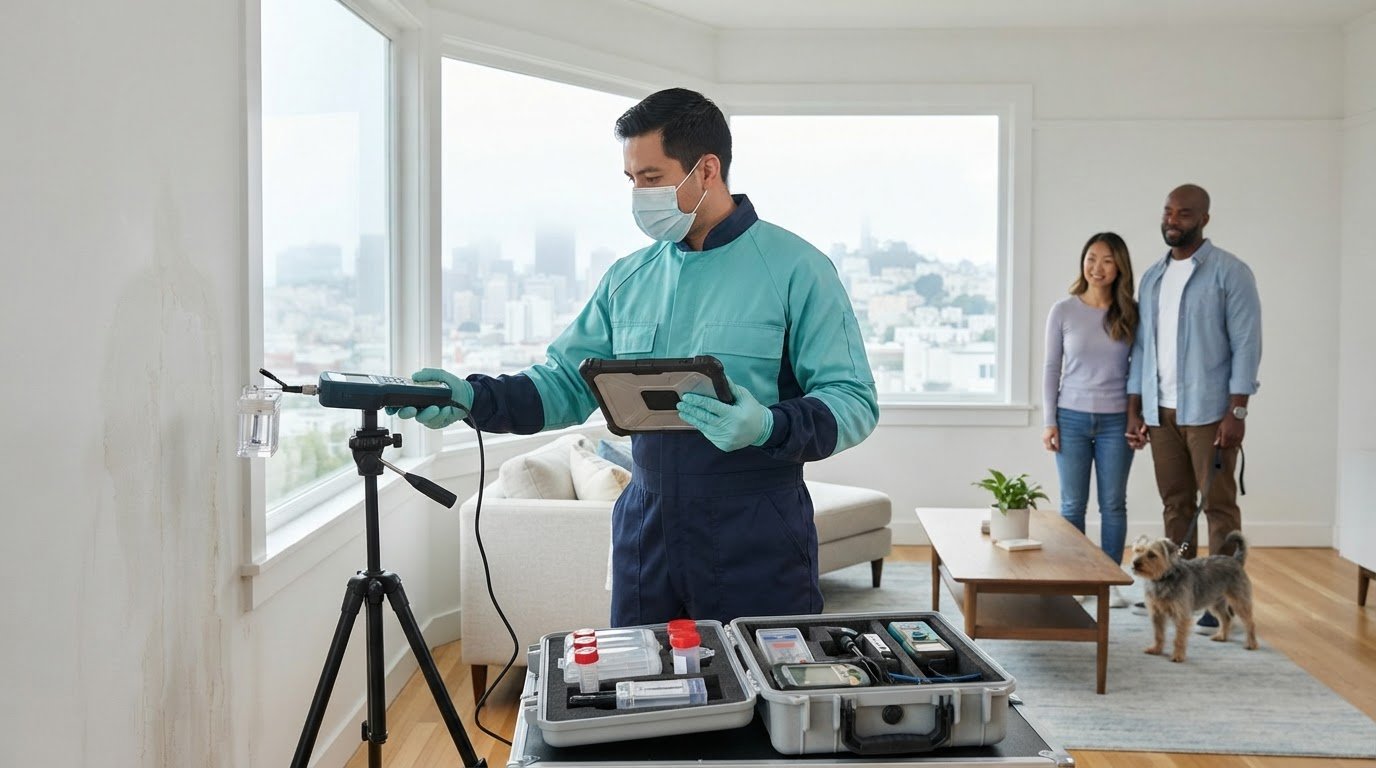
In San Francisco, a damp patch isn't just an ordinary maintenance headache; under local municipal health codes, indoor mold is legally recognized as a public health nuisance. When a resident raises habitability concerns or hints at rent withholding, subjective arguments only escalate tension. Securing certified mold testing for landlords sf establishes a clinical, scientific baseline that immediately replaces guesswork with objective evidence.
It's entirely natural to feel uneasy when balancing strict California habitability standards against tenant lifestyle factors, especially when facing potential San Francisco Rent Board disputes. Determining whether elevated moisture stems from building conditions or daily resident habits shouldn't rely on speculation, nor should it depend on inconclusive home test kits that carry no legal weight in a formal hearing.
This guide explains how San Francisco property owners can navigate complex local habitability mandates, verify air quality complaints, and secure defensible laboratory documentation to protect their investments. We'll explore municipal compliance standards, laboratory chain-of-custody protocols, and the essential steps to take if elevated spore counts require targeted remediation.
Key Takeaways
- Understand how California habitability statutes and local health codes classify indoor fungal growth, protecting your property against administrative citations and formal disputes.
- Discover when ordering professional mold testing for landlords sf is critical, particularly during tenant turnover and after receiving written moisture reports.
- Learn why calibrated air cassette sampling and certified laboratory chain-of-custody data provide legally defensible evidence that over-the-counter test kits cannot supply.
- Gain clarity on reading laboratory analysis reports, including how to evaluate indoor fungal ecology against outdoor baseline control samples.
- See how accurate diagnostic metrics inform targeted, non-destructive remediation strategies that resolve air quality concerns without prolonged resident displacement.
San Francisco Landlord Legal Obligations: Mold, Habitability, and the Law
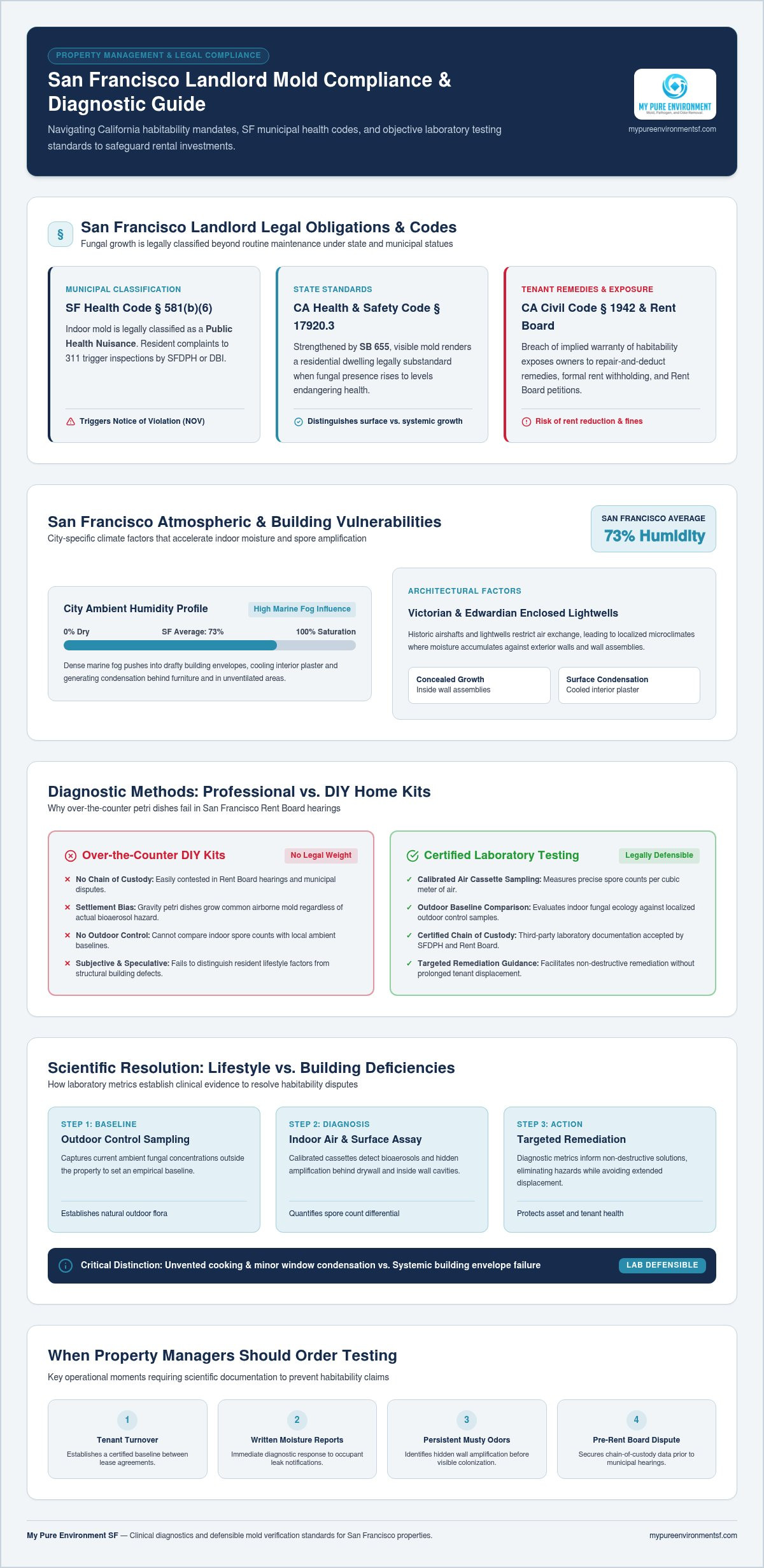
Under California law, the implied warranty of habitability mandates that residential rental units remain structurally sound, clean, and safe for human occupation. When microbial growth develops, housing providers face immediate exposure to tenant repair-and-deduct remedies under California Civil Code § 1942, formal rent withholding, or rent reduction petitions before the San Francisco Rent Board. Implementing professional mold testing for landlords sf provides verifiable, clinical data that replaces heated tenant arguments with objective evidence.
California Health & Safety Code and Substandard Housing
California Health & Safety Code Section 17920.3 specifies that visible mold renders a residential dwelling legally substandard when fungal presence rises to a level that endangers tenant health. For a comprehensive overview of indoor mold and its physiological dynamics, medical consensus confirms that concentrated bioaerosols can impair respiratory wellness. State legislation, strengthened by measures like SB 655, distinguishes minor cosmetic surface condensation from systemic fungal colonization driven by building failures. While minor bathroom moisture can often be resolved with routine cleaning, hidden growth within wall assemblies requires professional diagnostic evaluation.
The Role of the SF Department of Public Health (SFDPH)
San Francisco enforces habitability through municipal health channels. Under San Francisco Health Code § 581(b)(6), demonstrable mold is classified as a public health nuisance. When a resident dials 311, inspectors from the SF Department of Public Health (SFDPH) or the Department of Building Inspection (DBI) investigate the unit. If inspectors identify visible fungal growth or elevated moisture, SFDPH issues an official Notice of Violation (NOV). Housing providers face strict compliance windows to halt moisture intrusion and eliminate the hazard. Missing these mandated deadlines can prompt escalated reinspection fees, municipal fines, and enforcement proceedings.
Protecting Rental Investments Through Objective Compliance
Navigating habitability claims requires clear separation between tenant lifestyle factors, such as unvented cooking or window condensation, and structural building envelope deficiencies. Utilizing certified mold testing for landlords sf establishes a legally defensible third-party baseline before tenant disagreements escalate. Consulting the San Francisco mold testing guide for property owners provides a practical framework for deploying accredited air and surface sampling, shielding asset value while ensuring tenant living spaces remain healthy and compliant.
When Should Property Managers Order Professional Mold Testing in SF?
Routine building maintenance handles leaky faucet washers, but ambiguous moisture complaints demand an empirical response. Knowing precisely when to commission certified mold testing for landlords sf safeguards real estate investments against unseen contamination while maintaining open communication with residents.
Responding to Tenant Complaints and Health Symptoms
When occupants report persistent musty odors, unexplained drywall discoloration, or lingering respiratory irritation, visual reviews rarely reveal the full story. While the EPA guide to mold and moisture notes that sampling can be omitted when growth is plainly visible on surfaces, concealed amplification often hides inside wall assemblies. Logging tenant notices promptly and scheduling an independent air assessment provides objective data, preventing subjective grievances from escalating into formal habitability petitions.
SF Microclimates and Historic Architecture Vulnerabilities
San Francisco's unique atmospheric conditions accelerate moisture retention. With the city's average ambient humidity reaching 73%, dense marine fog pushes into drafty building envelopes, cooling interior plaster and generating condensation behind furniture. Historic architectural designs carry distinct vulnerabilities:
- Enclosed lightwells: Victorian and Edwardian airshafts often trap unvented kitchen or bath moisture, venting back into adjacent units.
- Subgrade ground-floor basements: Below-grade storage rooms and garden apartments pull continuous ground vapor through unsealed perimeter masonry.
- Single-pane bay windows: Uninsulated window frames produce persistent winter runoff that degrades surrounding wood framing.
Pre-Lease and Post-Leak Verification Protocols
Because fungal colonization can start within 24 to 48 hours of water exposure, verifying hidden dryness after pipe leaks or roof failures is vital. Performing clinical air sampling ensures interior wall cavities dried thoroughly without harboring active microbial activity. Incorporating baseline assessments during tenant turnover also secures clear proof of unit safety before a new lease begins. Review our resource on mold and indoor air quality in San Francisco to refine your turnover checklist, or consult My Pure Environment SF to schedule certified diagnostic testing across your portfolio.
Comparing Mold Testing Methods: Air Spore, Surface, and DIY Kits
Selecting the appropriate diagnostic method makes the difference between an open-and-shut resolution and a protracted legal challenge. Housing arbiters demand objective, verifiable proof when reviewing property conditions. Professional mold testing for landlords sf relies on laboratory protocols designed to quantify airborne ecology accurately, rather than uncalibrated visual indicators.
Air Spore Trap Sampling vs. Surface Tape Lifts
Professional diagnostics utilize calibrated volumetric air pumps attached to specialized spore trap cassettes. These instruments draw a precise volume of air over a set timeframe, capturing both viable and non-viable fungal spores on a treated slide. Technicians establish essential outdoor baseline control samples concurrently to compare interior air against ambient atmospheric conditions. When visible discoloration is present on baseboards or drywall, direct surface tape lifts or sterile swabs confirm whether the stain represents active microbial colonization or harmless residual staining.
Why DIY Hardware Store Test Kits Fail Landlords
Over-the-counter home testing kits rely on gravity settle plates that invariably cultivate fungi, simply because airborne spores exist naturally in every residential environment. In administrative hearings or rent board dispute proceedings, these DIY kits carry no evidentiary weight for several reasons:
- No volumetric calibration: Settle plates do not measure air volume, making it impossible to determine actual spore concentrations per cubic meter.
- Lack of chain of custody: Without strict handling protocols by certified third-party inspectors, samples can easily suffer contamination or mishandling.
- False alarm triggers: Culturing ambient outdoor species often generates dramatic fungal colonies that unnecessarily alarm residents without reflecting genuine building defects.
Meeting the legal benchmarks established by California's habitability laws requires formal reports generated by AIHA-accredited laboratories operating under strict chain-of-custody documentation.
Specialized Room Inspections: Bathrooms and Attics
Diagnostic testing often isolates specific high-risk zones where moisture concentrates naturally. Poor mechanical exhaust in older flats makes targeted bathroom mold removal in San Francisco a frequent operational requirement. Similarly, unconditioned roof rafters and soffits require precise assessments; our protocols for attic mold remediation in San Francisco evaluate structural airflow to confirm whether condensation stems from roof penetrations or inadequate attic ventilation.
Interpreting Laboratory Test Reports to Resolve Tenant Disputes
Receiving an accredited laboratory report transforms an emotional tenant grievance into an objective scientific discussion. However, raw environmental data can feel overwhelming without a clear framework for interpretation. Professional mold testing for landlords sf provides property managers with quantifiable metrics to determine whether an indoor environment has active amplification or simply reflects normal ambient ecology.
Understanding Spore Counts, Genus Types, and Baselines
Laboratory reports measure fungal concentration in raw counts and spores per cubic meter (spores/m³). Step one in evaluating results involves comparing indoor rooms directly against the outdoor baseline control sample. In a healthy living space, indoor spore concentrations should mirror or remain significantly lower than the outdoor air.
Step two requires examining specific fungal genera. While common outdoor varieties like Cladosporium drift inside through open windows, water-indicator species tell a different story. Elevated concentrations of Penicillium, Aspergillus, or toxigenic species such as Stachybotrys chartarum signal chronic moisture intrusion that demands targeted remediation rather than casual ventilation.
Attributing Root Causes: Building Envelope vs. Tenant Lifestyle
Step three correlates the laboratory spore profiles with moisture meter readings and thermal imaging to isolate the root source. Systemic fungal presence along bottom sill plates often indicates hidden plumbing failures or exterior envelope breaches, both of which fall squarely under landlord maintenance duties. Conversely, widespread surface growth on window glass and cold perimeter drywall, coupled with dry underlying framing, typically points to tenant-generated humidity from unvented cooking, indoor laundry drying, or neglected bathroom fan usage.
Transparent Tenant Communication and Dispute Resolution
Step four focuses on distribution and resolution. Sharing the complete laboratory package transparently with the resident establishes good faith and dispels exaggerated health fears. When the data shows clean air quality, you can present actionable moisture control recommendations, like maintaining indoor relative humidity below 50% with digital hygrometers. If elevated spore counts confirm an active issue, the testing roadmap guides precise remediation before formal Rent Board petitions arise. Facing a complex dispute? Schedule an unbiased professional mold inspection to secure clear, legally defensible answers.
From Testing to Remediation: Best Practices for SF Rental Properties
A confirmed laboratory report shouldn't trigger immediate structural demolition. When diagnostics pinpoint elevated counts, the goal is targeted remediation aligned directly with the data. Professional mold testing for landlords sf shapes an accurate scope of work, treating affected micro-environments while leaving sound building materials intact.
Minizing Tenant Displacement and Reconstruction Costs
Traditional remediation often tears out drywall indiscriminately, forcing housing providers to fund costly temporary tenant relocations under San Francisco administrative codes. Non-destructive remediation methodologies eradicate airborne and surface spores using specialized non-invasive treatments without disruptive demolition. Exploring the scientific framework outlined in professional mold remediation in San Francisco demonstrates how owners can neutralize biological contaminants rapidly, eliminating prolonged resident displacement and rent abatement claims.
Post-Remediation Verification (PRV) Clearance Testing
Remediation is only complete once documented through objective verification. Post-Remediation Verification (PRV) testing involves taking follow-up volumetric air samples within the treated containment area prior to full re-occupancy. AIHA-accredited laboratory clearance certificates supply definitive proof that airborne spore concentrations have returned to normal environmental baselines. Archiving these clearance records in property files satisfies municipal health inspectors, closes out open administrative inquiries, and shuts down future habitability disputes.
Proactive Building Envelope and Ventilation Management
Maintaining sustainable habitability requires permanent moisture control once indoor air returns to healthy levels. Property managers protect their portfolios over the long term by instituting proactive environmental controls:
- Automated ventilation: Replace standard toggle switches with continuous, humidistat-controlled exhaust fans that trigger whenever relative humidity climbs above 55%.
- Seasonal assessments: Schedule semi-annual checks of roof gutters, exterior stucco cladding, and subgrade foundation walls to catch water penetration before fungal spores amplify.
- Turnover testing: Implement routine mold testing for landlords sf during lease transitions to ensure an unbroken chain of verified indoor air quality documentation.
Protect your rental investment with certified mold testing and remediation from My Pure Environment SF.
Protecting Your Rental Investment with Scientific Clarity
Operating rental housing in San Francisco doesn't have to feel like walking an administrative tightrope. When tenant moisture complaints arise, objective science provides the clearest path forward. Scheduling professional mold testing for landlords sf replaces heated disputes with empirical data, clearly distinguishing tenant lifestyle habits from genuine building defects while maintaining alignment with municipal habitability standards.
Securing AIHA-accredited third-party laboratory analysis delivers the legally defensible documentation required to resolve SF Rent Board inquiries with complete confidence. Backed by deep specialization in San Francisco historic architecture and local habitability regulations, diagnostic air sampling enables targeted, non-destructive remediation protocols designed to prevent unnecessary tenant displacement. Objective verification protects your rental assets, reassures residents, and keeps your units operating safely. Protect your rental property with certified mold testing from My Pure Environment SF and maintain complete control over your indoor building health.
Frequently Asked Questions
Is a landlord legally required to test for mold in San Francisco?
No California statute explicitly mandates proactive mold testing prior to leasing a property. However, state law requires distributing the California Department of Public Health dampness booklet and disclosing known mold hazards. When an occupant files a written complaint reporting persistent moisture or related health issues, ordering professional testing becomes an indispensable risk-management step to evaluate habitability claims under local municipal health codes.
Can a San Francisco tenant withhold rent if mold is present?
Yes, California Civil Code § 1942 permits tenants to withhold rent or exercise repair-and-deduct options if unaddressed conditions breach the implied warranty of habitability. This legal protection requires that the tenant provided formal notice and that microbial growth endangers health rather than consisting of minor surface condensation. Defensible diagnostic data confirms whether a unit meets habitability thresholds before formal disputes reach the SF Rent Board.
What is the acceptable level of mold spores in a rental unit?
Neither California nor federal environmental agencies define specific numerical thresholds for permissible airborne spore counts. Acceptability is determined comparatively through certified mold testing for landlords sf. An accredited laboratory evaluates indoor air cassette samples against an outdoor control collected at the same time. A healthy rental should exhibit indoor spore levels and genus types that mirror or remain lower than ambient outdoor air.
Why are DIY home mold test kits inadvisable for landlords?
Over-the-counter petri dish kits are virtually useless in administrative hearings because they lack volumetric calibration and certified chain-of-custody tracking. Gravity settle plates culture ubiquitous ambient spores that exist in every home, inevitably producing alarming fungal colonies. Without measuring exact spores per cubic meter or providing accredited laboratory documentation, DIY kits create unwarranted panic and fail to withstand legal scrutiny during tenant arbitration.
Who pays for mold testing if the tenant caused the problem?
Property owners typically pay for initial environmental diagnostics to evaluate habitability obligations promptly. If clinical inspection data and moisture assessments confirm that mold developed strictly from resident actions, such as shutting off mechanical bathroom vents or drying unvented laundry indoors, owners can often recover inspection and remediation expenses under standard lease provisions that hold tenants accountable for tenant-created moisture damage.
What happens if the San Francisco Department of Public Health inspects my rental?
If an SFDPH inspector identifies visible or demonstrable fungal growth during an inspection, the department issues an official Notice of Violation (NOV). Housing providers must eliminate the moisture source and remediate the biological growth within strict compliance windows. Scheduling professional mold testing for landlords sf establishes clear baseline evidence, informs an accurate scope of work, and confirms complete clearance to satisfy municipal housing authorities.
How long does professional mold testing take from sampling to lab results?
An on-site property inspection generally requires one to two hours, depending on property size and structural complexity. Air cassette and surface samples are dispatched immediately to an accredited environmental laboratory under strict chain of custody. Comprehensive laboratory reports detailing spore concentrations, genus identifications, and comparative outdoor baseline analyses are typically ready for review within two to three business days.