

What if a home that looks sound during a standard inspection still has hidden moisture behind a wall or beneath an attic surface? In San Francisco, fog, coastal humidity, and older building materials can create conditions where mold concerns are not obvious. It is understandable to want a clearer picture before committing to a major purchase, especially when unexpected repairs could add to an already significant investment. A mold inspection for home buyers sf can help investigate concerns a general inspection may not fully assess.
This guide explains how a specialized inspection can complement a general home inspection and help you make a more informed decision before closing escrow. You will learn what an inspector may look for, how air testing differs from surface sampling, and how findings can inform conversations with the seller or your real estate team.
You will also find practical next steps if mold is identified, including questions to ask about the findings and any proposed work. The goal is to help you assess the property calmly, understand your options, and move forward with a clearer view of its condition.
Key Takeaways
- A general home inspection may not assess hidden mold risks, so learn when a specialized inspection can provide a closer look before closing.
- San Francisco’s coastal conditions and older building features can contribute to concealed moisture concerns worth checking during a walkthrough.
- Air sampling and surface testing can reveal different information. The right method depends on the concern being investigated.
- Use this mold inspection for home buyers sf guide to spot potential warning signs and prepare informed questions about inspection findings.
- If mold is identified, learn how report findings can support seller discussions and help you evaluate possible next steps.
Why Standard Home Inspections Often Miss Mold in San Francisco
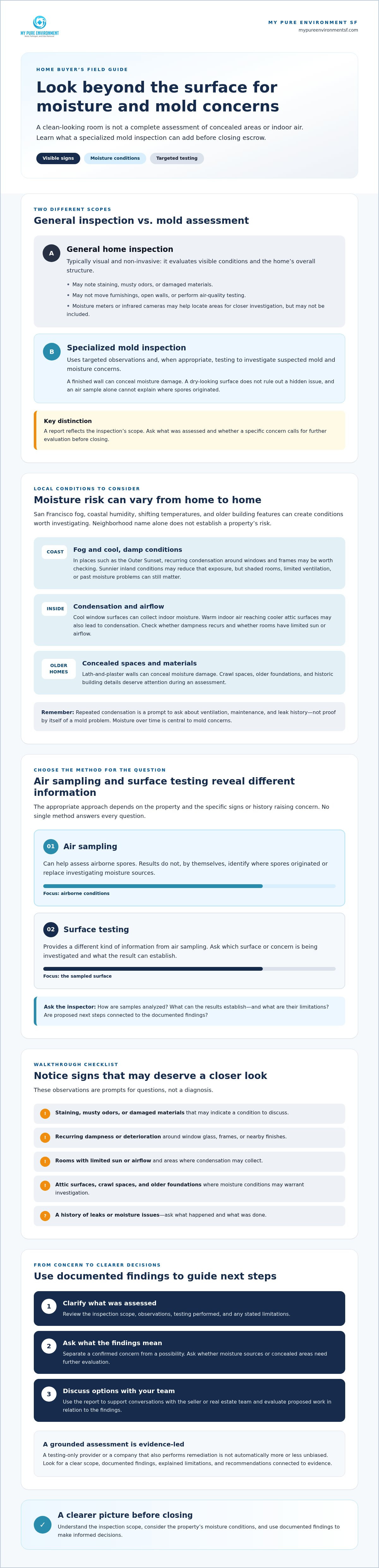
A general home inspection is valuable, but it has a different purpose from a mold assessment. The inspector typically evaluates visible conditions and the home’s overall structure. A clean-looking room does not confirm that concealed areas or indoor air have been assessed for mold. In older San Francisco homes, lath-and-plaster walls can conceal moisture damage, while mold may develop out of sight when damp conditions persist. A specialized mold inspection uses targeted observations and, when appropriate, testing to investigate suspected mold and moisture concerns.
Understanding what indoor mold is helps clarify why a visual walkthrough has limits. Growth depends on environmental conditions, and not every concern is visible on a finished surface. Air sampling can help assess airborne spores, but it is not a universal answer or a substitute for investigating moisture sources. The appropriate inspection approach depends on the property and the specific signs or history that raise concern.
The Limitations of a General Home Inspector
A standard inspection is generally visual and non-invasive. Inspectors may note staining, musty odors, or damaged materials, but they may not move furnishings, open walls, or perform air-quality testing. Moisture meters and infrared cameras can help identify areas that warrant closer investigation, but their use is not necessarily included in a general inspection. The report also reflects its scope: an inspector may document a visible condition without making a definitive claim about mold that has not been tested.
That distinction matters in a home with finished walls. A dry-looking surface does not rule out a concealed moisture issue, and a single air sample cannot by itself explain where spores originated. Ask what the general inspection covered and whether specific concerns call for mold testing and inspection before closing.
The “Conflict of Interest” Myth in SF Real Estate
Buyers sometimes question whether to choose a testing-only provider or a company that also performs remediation. Neither model automatically guarantees an unbiased assessment. Focus instead on a clear scope, documented findings, and an explanation of any limitations. A provider familiar with remediation may be able to discuss treatment considerations, but recommendations should be connected to the inspection findings.
My Pure Environment SF provides mold testing, inspection, and remediation services. Ask how samples are analyzed, what the results can and cannot establish, and whether proposed next steps are tied to the evidence. That information can help you distinguish a confirmed concern from a possibility and decide whether further evaluation is appropriate. For mold inspection for home buyers sf, the aim is a clearer understanding of the property before you commit, not unnecessary alarm.
San Francisco Climate Factors and Hidden Mold Risks
San Francisco’s mold risks can vary from block to block. In the Outer Sunset, frequent fog and cool, damp conditions can leave windows and frames prone to condensation. A few miles inland, a sunnier microclimate may reduce that exposure, though shaded rooms, limited ventilation, or a past moisture problem can still create conditions for mold. A home in Noe Valley and one in the Richmond should not be assessed by neighborhood name alone. Consider the property’s exposure, ventilation, and signs of persistent dampness.
The key is moisture over time. The EPA guide to mold and moisture explains why controlling moisture is central to preventing mold. For buyers, condensation that repeatedly collects on window glass or frames is a useful prompt to ask about ventilation, maintenance, and any history of leaks. One damp morning alone does not establish a mold problem.
The Impact of the SF Marine Layer
Coastal fog and shifting temperatures can cool window surfaces, allowing indoor moisture to condense. Check window frames and nearby finishes for recurring dampness or deterioration, particularly in rooms that get little sun or airflow. Temperature changes can also affect attic conditions: if warm indoor air reaches cooler attic surfaces, condensation may form. Buyers concerned about roof-space conditions can learn more about attic mold remediation in San Francisco.
Common Moisture Traps in Historic SF Homes
Victorian and Edwardian homes may have crawl spaces, older foundations, and building details that deserve a careful look. An uninsulated crawl space can be cool and damp. Air movement through a multi-story home, sometimes described as the stack effect, may carry air from lower levels upward. That movement does not prove mold is present, but it makes the condition of lower-level spaces relevant to the overall indoor environment.
In older neighborhoods such as Pacific Heights, the age of a home can make plumbing history and maintenance worth asking about. In tightly packed row houses, shared walls and limited exterior exposure may also affect airflow and drying. During a viewing, note musty odors, water staining, and persistent condensation, then ask whether the seller knows of prior moisture issues. Bathroom ventilation and damp finishes merit attention too. See bathroom mold removal in San Francisco for more context.
A mold inspection for home buyers sf should account for the home’s actual conditions, not rely on a citywide assumption. If you are unsure how to interpret moisture or air-quality concerns in a San Francisco property, My Pure Environment SF provides mold testing and inspection informed by local building types.
Comparing Mold Inspection Methods: Air Sampling vs. Surface Testing
No single test answers every question about a property. Air sampling can assess airborne spores in a particular place and moment, while a surface swab examines growth that is already visible. Neither test alone identifies every hidden moisture source or proves the full extent of a problem. A thorough assessment pairs appropriate sampling with a building evaluation, so results are interpreted alongside the home’s condition and moisture history.
Moisture mapping uses instruments to locate areas with elevated moisture that may not yet show visible damage. Thermal imaging can reveal temperature differences, including cold spots where condensation may occur. These tools help guide an investigation, but they do not confirm mold by themselves. A cool area or moisture reading needs context and, when warranted, further evaluation. The EPA guide to mold also emphasizes moisture control as central to understanding and addressing mold concerns.
When to Use Air Quality Testing
If a home smells musty but looks clean, air sampling may help assess whether airborne spores are present in the indoor environment. A specialist may compare indoor samples with an outdoor baseline, then consider the types and relative levels of spores alongside the inspection findings. Results are not a standalone verdict. Outdoor conditions, sampling location, and activity in the home can affect what a sample captures. Learn more about mold and indoor air quality in San Francisco.
The Role of Laboratory Analysis
Laboratory analysis can identify and characterize material collected in a sample. For a surface swab, that may help distinguish the kinds of mold present on the sampled spot, such as Stachybotrys or Aspergillus. A spore trap report typically describes airborne particles captured in a sample. Read its findings with the sampling location, outdoor comparison, and visible or moisture-related evidence in mind. There is no single result that should be treated as a universal pass-or-fail threshold.
For buyers, a written report with laboratory findings can make concerns easier to explain during discussions with the seller. It documents what was sampled and observed, helping support questions about further evaluation or possible repair terms. It does not automatically determine the cost or scope of work, so ask the inspector to clarify limitations and recommended next steps. A careful mold inspection for home buyers sf should connect test results to the building evidence rather than relying on a number alone.
My Pure Environment SF provides mold testing and inspection in San Francisco. For buyers weighing indoor air concerns, San Francisco mold testing and inspection can help clarify what an assessment may address.
A Home Buyer’s Checklist: Red Flags to Spot During a Walkthrough
A walkthrough cannot confirm whether mold is present, but it can help you identify clues to investigate before closing. Look for patterns, take notes, and ask the seller or your real estate team about signs that appear more than once. One mark alone may have several explanations. Recurring dampness, odors, or damaged finishes deserve follow-up.
- Baseboards and lower walls: Check kitchens and bathrooms for bubbling paint, swollen trim, or warping, which can indicate repeated moisture exposure.
- Musty odors: Notice smells in basements, lower-level units, closets, and other spaces with limited airflow. An odor is a clue, not proof of mold.
- Attic surfaces: If the attic is safely accessible, look for dark staining on roof sheathing or other visible signs of moisture. Do not disturb suspected growth.
- Windows: Ask about persistent condensation on double-pane windows and inspect nearby frames and finishes for recurring dampness or deterioration.
Exterior Red Flags in SF Properties
Before or after the interior viewing, look at the building exterior from accessible areas. Check whether gutters and downspouts appear clogged or direct water toward the foundation. Note stucco cracks, failing paint, or vegetation pressed close to siding, where moisture may be slow to dry. These observations do not establish that water has entered the home, but they can help you ask focused questions about maintenance and past moisture issues.
Basement and Crawl Space Warning Signs
In lower-level spaces, look for efflorescence, a white, powdery deposit on concrete that can be associated with moisture moving through masonry. Notice whether a dehumidifier is running and ask why it is used, how often the space feels damp, and whether there is a history of water intrusion. A running appliance alone does not prove a problem, but it is useful context. Do not enter areas that are not safely accessible during a showing.
Record what you see, where you saw it, and any answers you receive. Photos can help you describe visible concerns to your inspector, but they cannot replace a professional assessment. For guidance on what testing may clarify, read this San Francisco mold testing guide.
If you find several warning signs or a persistent musty odor, consider whether a mold inspection for home buyers sf is appropriate before you close. Learn about mold testing and inspection options to understand how a focused assessment can help clarify concerns.
Navigating Mold Findings: Negotiation and Possible Solutions
A mold finding does not automatically mean you need to walk away from a home. Start by reviewing the inspection report: note where concerns were observed, what testing found, and what the inspector recommends next. You can share that documentation with your real estate agent and ask the seller about options, which may include a repair credit or having the issue addressed before closing. The report supports the conversation, but it does not set the credit amount or guarantee an agreement.
Take health concerns seriously without relying on a label such as “toxic mold” alone. Mold identification and sampling results need to be interpreted in context, alongside visible conditions and moisture sources. If the report raises concerns, discuss appropriate next steps with a qualified professional before moving in, particularly if household members have sensitivities or health concerns.
What to Ask About Remediation
My Pure Environment SF provides mold remediation and indoor air quality improvement services. If you are comparing proposed approaches, ask what areas and conditions the work addresses, whether access to concealed areas is needed, and how any underlying moisture concern will be evaluated. No treatment method should be assumed to reach or resolve every concealed issue. Read about professional mold remediation in San Francisco for more information.
Before agreeing to a plan, clarify whether the findings point to visible growth, airborne concerns, a moisture source, or a combination. Remediation may address mold, but persistent moisture can allow problems to return if it is not addressed. A post-remediation verification (PRV) assessment, which may include inspection and testing, can document conditions after the work. Ask who will perform it, what it will evaluate, and how results will be reported.
Final Steps Before Closing
If the seller arranges work, request written details about its scope and the person or company performing it. Rather than assuming a contractor’s qualifications, verify relevant experience and credentials for the work in question. Ask whether any written warranty is available and, if so, whether it can transfer to you. Confirm the schedule for remediation and any follow-up assessment with your real estate team before setting expectations for move-in.
A mold inspection for home buyers sf can turn an uncertain finding into documented questions and practical next steps. To discuss mold testing or remediation for a San Francisco property, contact My Pure Environment SF about a mold inspection for your potential new home.
Move Toward Closing with Greater Confidence
A San Francisco home can look well maintained while still having moisture concerns that deserve a closer assessment. A specialized inspection can complement a general home inspection, while air and surface testing answer different questions. Documented findings can also help you have more informed discussions with the seller about next steps.
Choose an assessment that considers the property’s specific conditions and explains what the findings can and cannot establish. My Pure Environment SF provides mold testing and inspection, as well as mold remediation and indoor air quality improvement services in San Francisco.
Use mold inspection for home buyers sf as a practical step toward understanding a property before you close, not as a reason to assume the worst. With clear information and thoughtful follow-up, you can make your next decision with greater confidence. Contact My Pure Environment SF to discuss mold testing and inspection for a San Francisco property.
Frequently Asked Questions
Is a mold inspection required for home buyers in San Francisco?
A buyer mold inspection is not identified as a general requirement for purchasing a San Francisco home, but it may be useful when you see signs of moisture or have concerns about the property. California disclosure rules require sellers of residential properties with one to four units to disclose known hazardous conditions, including mold, through a Transfer Disclosure Statement. Disclosure and inspection are separate steps. Ask your real estate professional or legal adviser how current requirements apply to your transaction.
How much does a professional mold inspection cost in the Bay Area?
The cost depends on the property, inspection scope, and whether sampling is included. Before booking, ask what the assessment covers, whether air or surface samples are proposed, and whether laboratory analysis is included. A clear scope helps you understand what the findings can answer and whether any additional evaluation may be needed.
What happens if the mold inspection comes back positive during escrow?
A positive finding gives you information to discuss with your real estate agent and the seller, but it does not dictate a single outcome. Review the report’s observations, sample results, and recommendations, then ask whether further assessment or remediation is appropriate. Depending on your agreement and escrow deadlines, you may discuss having the issue addressed or requesting a credit. Keep communication documented and consult your agent or legal adviser about your options under the purchase contract.
Can I perform a mold test myself using a DIY kit?
You can use a consumer kit to collect a sample, but its results may not explain where mold is growing, what moisture condition is contributing to it, or how representative the sample is. Collection and interpretation matter. If you notice a musty odor, visible growth, or water staining during a San Francisco home purchase, professional mold testing and inspection can put sampling in context with the property’s condition and help identify useful next steps.
How long does a professional mold inspection take to complete?
Inspection time depends on the home’s size, layout, accessibility, and concerns being evaluated, so there is not one reliable duration for every property. Sampling and laboratory analysis can also affect when you receive a complete report. Before arranging an assessment during escrow, ask the provider how long the site visit and reporting process are expected to take, and share your transaction deadlines. That helps you plan without assuming results will be available immediately.
Will mold in the attic or crawl space affect my home loan approval?
Mold in an attic or crawl space does not automatically determine whether a loan is approved. Lender requirements can vary, and the decision may depend on the property assessment, the condition identified, and the loan program. If an inspection finds a concern, ask your lender and real estate professional whether documentation, repairs, or follow-up evaluation could affect your transaction. A mold report can describe findings, but it cannot predict a specific lender’s decision.
Is black mold common in San Francisco real estate?
There is not enough information here to say how common a particular mold type is in San Francisco homes. “Black mold” describes appearance, not a definitive identification. Different molds can look dark, and color alone cannot confirm a species or health risk. If you see dark growth or suspect concealed mold, avoid disturbing it and consider a professional assessment. Laboratory analysis of an appropriate sample may help identify what was collected.
What is the difference between mold testing and a mold inspection?
A mold inspection evaluates the property for visible signs, moisture conditions, odors, and areas that may warrant further investigation. Mold testing collects samples, such as air or surface samples, for analysis. Testing can add evidence, but it does not replace an inspection or identify every moisture source on its own. For mold inspection for home buyers sf, ask how the proposed assessment combines observations, sampling, and laboratory results to answer your specific concerns.