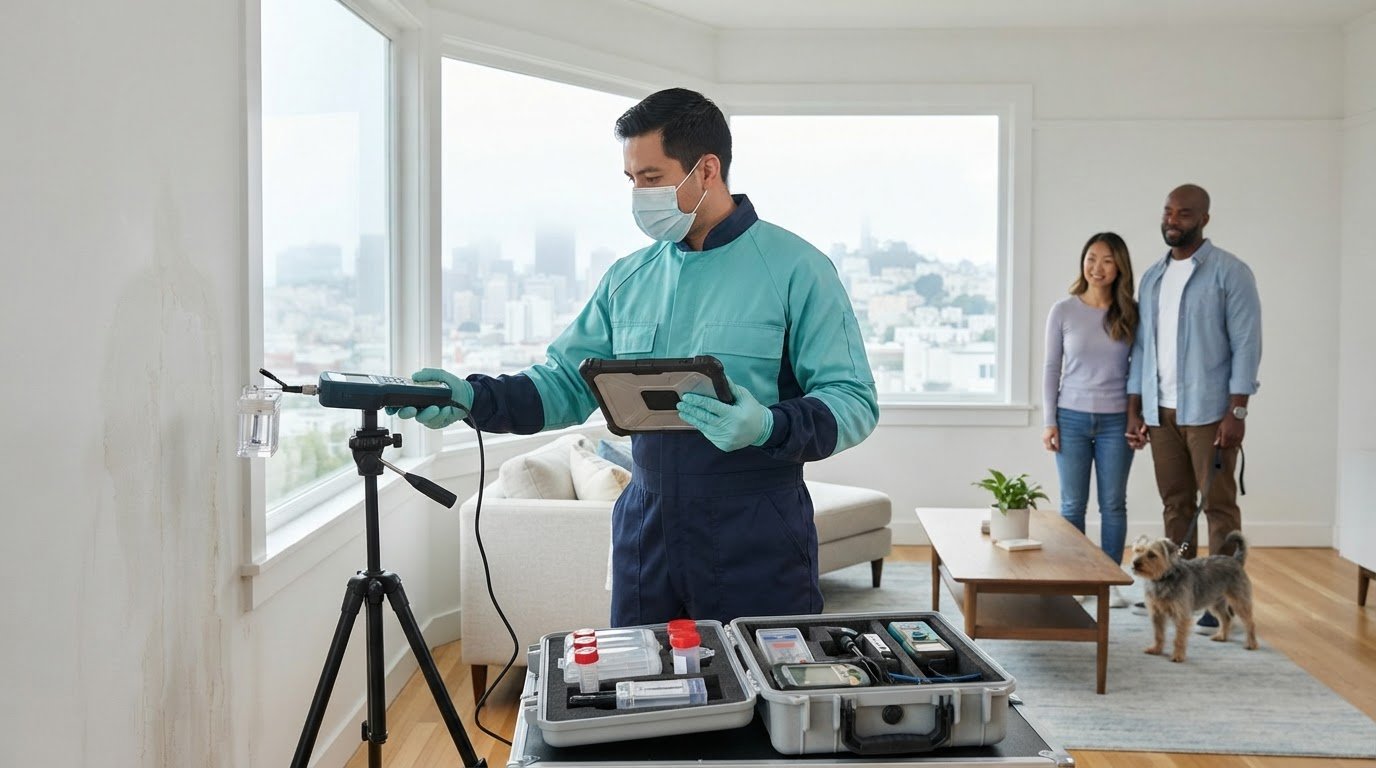

When a business faces a possible mold issue, uncertainty about the next steps can be more disruptive than the cleanup itself. A visible patch or musty odor can raise questions about the extent of the concern, its moisture source, and whether employees, tenants, or customers can continue using nearby spaces. Knowing how commercial mold remediation san francisco is assessed and planned can help you ask more useful questions from the start.
Those concerns are reasonable. A responsible plan should address more than visible growth. It should clarify the assessment, proposed scope, and how work will be coordinated with building operations. A provider focused on mold-related services can help you understand what is included and what may need to be handled separately.
This guide explains how to assess a commercial mold concern, compare remediation providers, and plan work around your San Francisco property. You’ll learn what a clear scope should cover, what to ask about testing, documentation, and moisture conditions, and when restoration or reconstruction may require a separate provider. With a better understanding of the process, you can identify a practical next step without relying on vague promises.
Key Takeaways
- Visible mold, suspected hidden growth, and confirmed findings call for different assessment steps. Don’t rely on appearance alone to judge the scope.
- Ask providers to define affected areas, proposed controls, responsibilities, access needs, and exclusions before work is scheduled.
- Compare commercial mold remediation san francisco providers by how clearly they explain moisture-source review, communication, documentation, and service boundaries.
- Reduce planning uncertainty by identifying decision-makers, occupants, operating hours, access points, and sensitive work areas in advance.
- Verify credentials and any claimed standards directly, and clarify whether restoration or reconstruction needs a separate provider.
When Does a San Francisco Business Need Commercial Mold Remediation?
Commercial mold remediation is a scoped response to mold growth and the moisture conditions that may contribute to it. The scope should reflect the property’s circumstances, not just the appearance of a spot. For a San Francisco office, retail space, or multi-tenant building, commercial mold remediation san francisco may involve assessing affected areas, considering the moisture source, and planning how work will interact with building use.
Visible growth is a reason to investigate, but it doesn’t confirm the mold type or the full extent of the concern. Persistent odors, moisture staining, or a history of leaks may prompt an assessment for possible hidden growth, even when none is visible. Findings depend on the assessment or testing appropriate to the situation. A comprehensive overview of indoor mold can provide general background, but it can’t determine what’s happening in a particular building.
Which signs warrant a professional commercial assessment?
Recurring visible growth, a persistent musty odor, and moisture staining are reasons to investigate, particularly if the issue returns after surface cleaning or appears in a shared area. These signs don’t identify a species or establish exposure risk on their own. Before contacting a specialist, note where and when you noticed the issue, whether it has changed, and any known leaks or moisture events. This information can help focus the assessment.
Why can commercial properties need a different plan?
A commercial assessment must account for how the building is used as well as the mold concern. Occupancy, operating hours, access routes, and shared systems can all affect coordination. An office may need communication among management, staff, and facilities teams. A retail space may have customer access to consider, while a managed building may involve several tenants or decision-makers.
These differences don’t mean a particular business type automatically needs a specific remediation method. They help identify questions to address in the scope and guide coordination with affected people. Persistent moisture, recurring growth, or a concern that may involve shared areas are good reasons to seek professional assessment rather than assume the issue is limited to what’s visible. My Pure Environment SF provides commercial mold testing and inspection, as well as mold remediation in San Francisco.
What Should a Commercial Mold Remediation Plan Include in San Francisco?
A useful remediation plan turns assessment findings into a defined scope of work. It should identify affected areas, describe proposed controls, clarify who is responsible for coordination, and state what is excluded. For commercial mold remediation san francisco, this detail helps property owners understand what the provider proposes and where responsibilities may need to be assigned to others.
The plan should also address moisture conditions connected to the mold concern. Removing visible growth without considering ongoing moisture may leave an important part of the problem unresolved. Ask what moisture observations informed the proposed scope and whether further investigation or separate work may be needed. If repairs or other services fall outside the provider’s scope, clarify that before scheduling.
Containment, work-area boundaries, and access arrangements should be discussed in relation to the specific building, rather than treated as identical requirements for every project. The EPA guidelines for commercial mold remediation offer background on planning and evaluating cleanup. Use them as a reference, then ask the provider to explain which controls are proposed for your property.
How should scope, containment, and access be discussed?
Ask how the work area will be defined and how access restrictions will be communicated to staff, occupants, or tenants. Request a plain-language explanation of the proposed controls and the spaces they cover. Confirm who will coordinate building access, furnishings, and sensitive business areas. Also ask how changes to the work boundary will be communicated if new conditions are found.
What documentation and follow-up should businesses ask about?
Before work begins, ask what assessment observations, work records, and closeout information the provider can supply. These details should help you understand what was addressed and what remains outside the agreed scope. Ask whether testing is relevant to the project’s objective. Testing isn’t automatically necessary for every remediation project. Its value depends on the question being asked and how the results will inform a decision.
Post-remediation testing or an independent assessment may be worth discussing when project goals call for separate verification. Ask who would perform it, what it would evaluate, and how results would be interpreted. For more detail on assessment options, consult a San Francisco mold testing guide. To discuss a commercial property concern with a local mold-focused provider, visit My Pure Environment SF’s commercial mold services.
How Can You Compare Commercial Mold Remediation Companies in San Francisco?
When comparing commercial mold remediation san francisco providers, focus on the proposed work and how clearly each provider explains it, not just the company’s general restoration profile. A mold-focused scope should make clear what the provider will assess and remediate, how moisture conditions will be considered, and where its responsibilities end. Ask each candidate the same questions so you can compare their answers consistently.
| What to compare | Questions to ask |
|---|---|
| Scope | Which areas and tasks are included? How will the affected areas and proposed work be explained? |
| Moisture-source review | What moisture conditions were observed, and how will they inform the plan? What may need further investigation? |
| Communication | Who will update staff, tenants, and building contacts about access, work boundaries, and changes? |
| Documentation | What assessment observations, work records, and closeout information will be provided? |
| Service boundaries | What is excluded? Would water damage restoration, construction, or rebuilding require another provider? |
Which questions reveal whether a provider fits your property?
Ask who will assess the concern and how findings will be translated into a clear scope. Discuss how occupants will receive access guidance and project updates, especially if shared spaces or multiple tenants are involved. Request a direct explanation of exclusions and any work that would require another contractor. For workplace safety context, review the OSHA guide to mold in the workplace and ask providers to explain how safety considerations apply to their proposed work.
How can you compare proposals without focusing only on price?
Read proposals side by side and compare included tasks, assumptions, documentation, responsibilities, and site access plans. A lower figure may reflect a narrower scope, while a more detailed proposal may identify work that another leaves unclear. Request a property-specific scope rather than relying on a generic estimate. Ask providers to substantiate claimed credentials or standards directly, and treat guarantees, health assurances, or broad promises as claims to examine, not proof of quality.
Also distinguish mold remediation from water damage restoration and reconstruction. A company may specialize in one area without offering the others, so confirm the boundary before selecting a provider and plan separately for any excluded work.
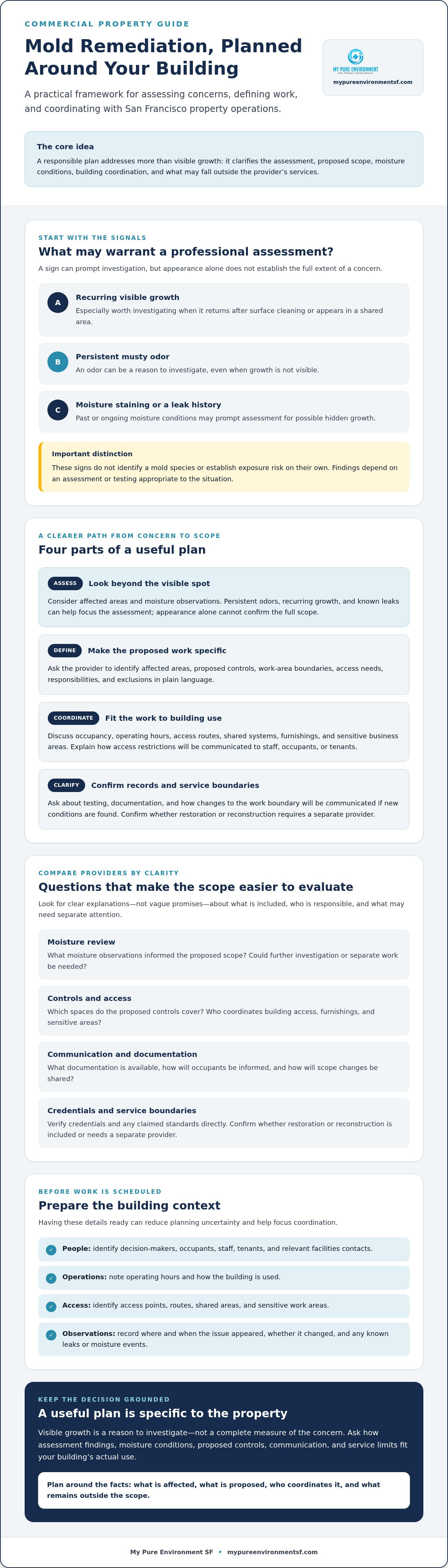
How Can San Francisco Businesses Prepare for Mold Remediation With Less Disruption?
Preparation is about coordination, not a promise that normal operations can continue unchanged. The right arrangements depend on the affected areas, proposed scope, and how the building is used. For commercial mold remediation san francisco, share practical details with the provider early so the work plan can account for occupants, access, and business priorities.
What should property managers and business operators organize first?
Choose a primary contact who can coordinate access, answer questions, and share updates with the provider and building occupants. Before the assessment or scheduled work, gather relevant maintenance notes and information about known leaks or previous moisture concerns. Record where and when you noticed signs of mold, but don’t disturb suspected materials. Discuss operating hours, access points, sensitive work areas, and occupant communication needs with the provider.
- Identify decision-makers and building contacts who need updates.
- Note affected locations and known moisture history.
- Discuss scheduling, access arrangements, and communication with staff or tenants.
How should remediation coordinate with other building work?
Clarify whether the agreed scope covers mold remediation only. Repairs beyond that scope, including construction or restoration work, may require a separate contractor. Before work begins, confirm who is responsible for each task and how providers will coordinate access and timing. This helps avoid gaps or overlapping assumptions. For additional process context, readers can consult a science-based San Francisco mold remediation guide.
Planning may also involve deciding whether some spaces need restricted access during work and how that will affect staff or tenants. Ask the remediation provider what changes to expect, who will communicate them, and how new findings could affect the schedule or scope. These discussions help your team prepare without assuming every project can proceed while operations remain unchanged.
My Pure Environment SF provides commercial mold remediation, testing, and inspection in San Francisco. If you’re organizing next steps, discuss your commercial mold concern and scope with the team.
How to Choose a Commercial Mold Remediation Partner in San Francisco
A good fit is a provider who can explain the proposed work clearly and define its limits. For commercial mold remediation san francisco, compare the clarity of each scope, attention to moisture conditions, communication plan, available documentation, and qualifications you can verify. Don’t treat broad service claims or confident promises as a substitute for answers specific to your property.
Before authorizing work, confirm which areas and tasks are included, how access will be coordinated, who will communicate with occupants, and what is excluded. Ask what findings could change the scope and whether testing is relevant to your project goals. If a provider cites credentials or a standard, ask for details and verify the claim directly.
What should you confirm before authorizing work?
Make sure you understand the plan and the handoffs. Confirm who is responsible for each task, how the provider will share updates, and what information you’ll receive at closeout. Ask whether the proposal addresses the moisture conditions connected to the concern. If repairs beyond mold remediation may be needed, clarify whether they require another trade so you can plan for that work separately.
What is a practical next step for a San Francisco business?
Gather the property address, affected locations, observations, and any known moisture or leak history. Note who manages the building and which occupants or areas may be affected. These details can help frame a discussion about whether mold inspection, testing, remediation, or a combination may fit the concern. If questions extend beyond mold to broader indoor air quality, ask what assessment or improvement options may be relevant.
My Pure Environment SF provides commercial mold remediation, mold testing and inspection, and indoor air quality improvement in San Francisco. The company doesn’t provide water damage restoration, rebuilding, or general construction, so those needs may call for a separate provider. Share the property details and ask what next step may fit. You don’t need to decide on a scope before discussing the concern.
Take the Next Step Toward a Clear Remediation Plan
A practical approach to commercial mold remediation san francisco starts with understanding what’s affected, considering the moisture conditions, and agreeing on a clear scope before work begins. Compare providers by how well they explain responsibilities, communication, documentation, qualifications, and exclusions. Then coordinate access and updates with the people who use or manage the property.
My Pure Environment SF provides commercial mold remediation and mold testing in San Francisco. If you’re ready to discuss what you’ve observed and which next step may fit your property, discuss commercial mold remediation for your San Francisco property.
A clear conversation can help turn uncertainty into a more informed plan for your business.
Frequently Asked Questions
When should a San Francisco business hire a commercial mold remediation company?
Consider professional assessment if mold growth keeps returning, musty odors persist, moisture staining appears, or the concern may involve shared areas. These signs don’t establish the extent of growth or identify mold species by appearance alone. Before reaching out, note the locations and dates of observations, along with known leaks or moisture history. A specialist can discuss whether inspection, testing, remediation, or a combination may fit the property concern.
What happens during commercial mold remediation?
The work should begin with an assessment and a scope that identifies affected areas, proposed controls, responsibilities, and exclusions. The provider should explain how access to work areas will be handled and how moisture conditions relate to the plan. Remediation addresses the identified mold concern, while follow-up and closeout information depend on the project scope. Ask what observations, work records, and next steps will be documented before authorizing work.
Can a business remain open during mold remediation?
Possibly, but it depends on the affected areas, proposed controls, access arrangements, and how the building operates. A provider shouldn’t assume normal operations can continue unchanged without reviewing the project conditions. Discuss operating hours, shared spaces, sensitive work areas, and occupant communication in advance. The remediation provider can explain expected access restrictions, while the business decides how to coordinate staff, tenants, or customers around the proposed work.
Does commercial mold remediation include water damage repair or reconstruction?
Not necessarily. Mold remediation, water damage restoration, and construction or rebuilding are distinct scopes, so confirm exactly which tasks a proposal includes. If a leak or other moisture condition needs repair, ask whether that work is included or requires a separate provider. My Pure Environment SF provides mold-related services in San Francisco, but does not offer water damage restoration, general construction, or rebuilding.
Is mold testing always needed before commercial remediation?
No. Testing is not automatically necessary for every project. It depends on the question the assessment needs to answer and how results would inform decisions. Visible growth, for example, may prompt an assessment without testing being the only possible next step. Ask the provider to explain the purpose of any proposed sampling, what the results can establish, and whether post-remediation testing is relevant to your project objectives.
How do I compare commercial mold remediation proposals?
Compare proposals by their included tasks, affected areas, moisture-source review, access arrangements, responsibilities, exclusions, and documentation. Check whether each provider explains assumptions and how the plan could change if new conditions are found. Avoid judging proposals only by a headline figure, since scopes may differ. Request a property-specific plan and clarify whether separate restoration or construction work is needed beyond the mold remediation scope.
What should I ask a commercial mold remediation company before hiring it?
Ask who will assess the property, how findings and the proposed scope will be explained, and how staff or tenants will receive access guidance and updates. Confirm what documentation is available, what work is excluded, and whether testing or another trade may be appropriate. Verify any credentials or standards the company claims directly. For commercial mold remediation san francisco, also confirm the provider’s service focus and fit for your property’s needs.