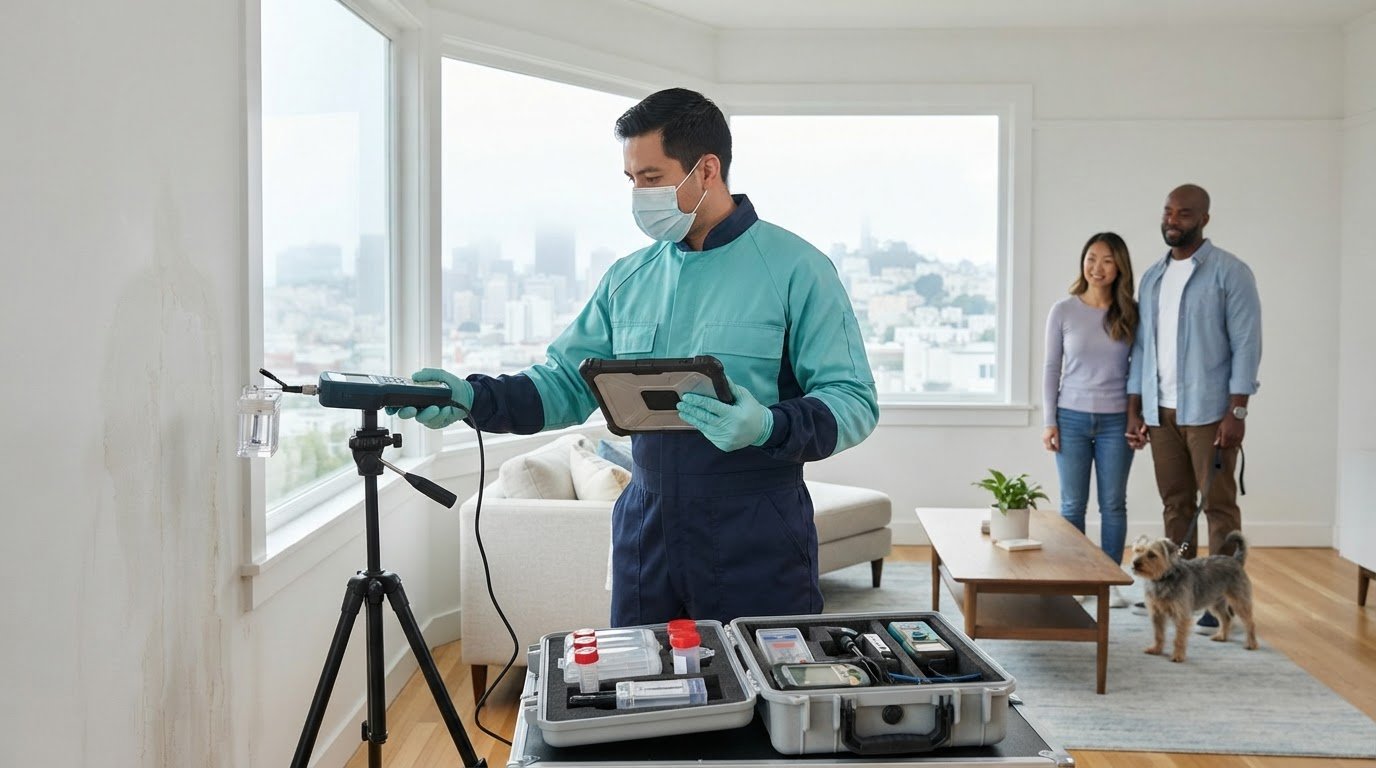
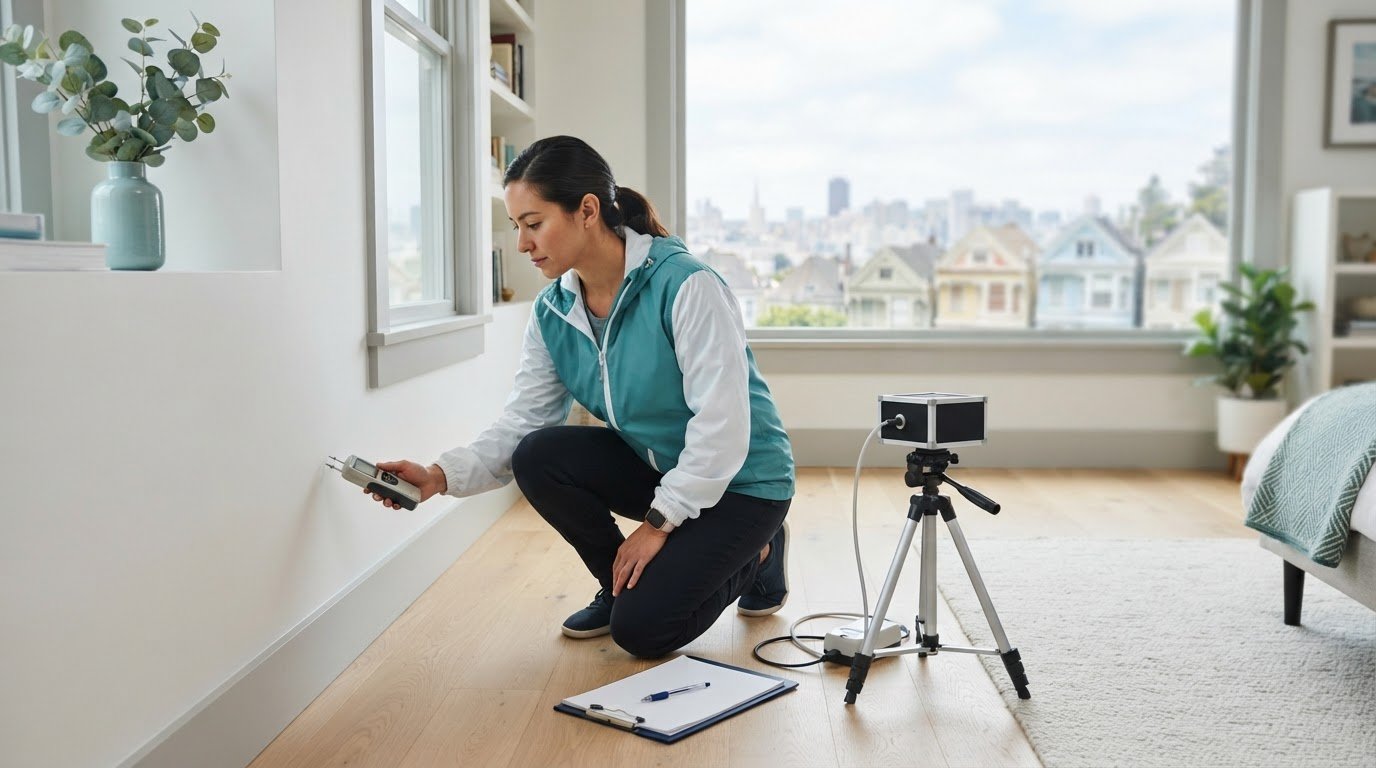
A room can look clean after remediation, but visible cleanup alone can’t show whether the agreed work addressed the affected areas. For San Francisco property owners, post remediation mold testing sf can help assess completed work. Its value depends on what is inspected, which sampling methods are used, and how findings are interpreted. Objective confirmation can be useful when you’re comparing a visual review with air or surface sampling, or deciding who should conduct the assessment.
This guide explains what a post-remediation assessment can evaluate and when sampling may add useful information. You’ll learn how to review a plan’s scope, methods, and success criteria, and what to ask about who performs the assessment. Testing can help determine whether the agreed remediation goals appear to have been met, but it can’t prove that a property is completely mold-free or medically safe. You’ll also find practical guidance for responding to findings and keeping records of the work and assessment.
Key Takeaways
- Match the assessment to the remediation scope, and make sure the plan states what completion will be evaluated against.
- Compare visual assessment, moisture observations, air sampling, and surface sampling by the questions each method can answer.
- When considering post remediation mold testing sf, ask who will assess the work, how any relationship with the remediation provider is disclosed, and what the final report includes.
- Share relevant updates, such as recent cleaning, repairs, or moisture events, so the assessor can interpret findings in context.
- Use the results to guide agreed next steps, and keep the assessment report with your remediation records.
What Post-Remediation Mold Testing in San Francisco Is Designed to Verify
After remediation, the key question isn’t simply whether a test detects mold. It’s whether the completed work matches the agreed scope and whether the assessed area shows conditions consistent with that work. A post-remediation assessment may combine a visual review, relevant moisture observations, and sampling when sampling is intended to answer a specific question. For background on mold and the conditions that support its growth, see this comprehensive overview of mold.
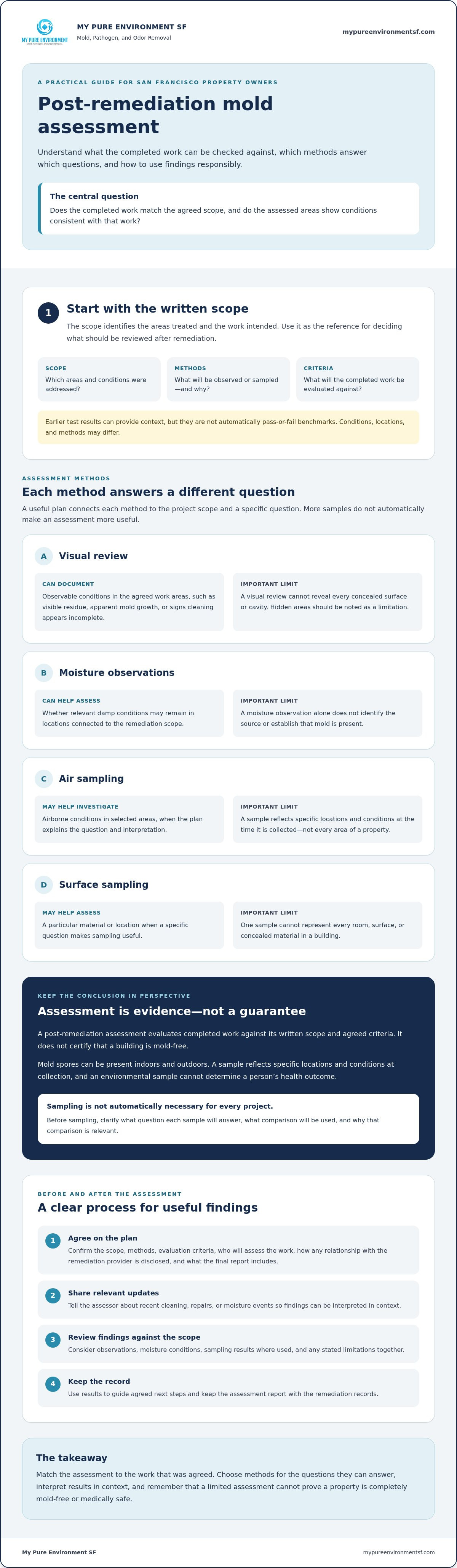
Post-remediation verification assesses completed work against its written scope and agreed evaluation criteria. It does not certify that a building is mold-free. The scope identifies which areas and conditions were addressed. The suspected moisture source matters, too. If moisture remains or returns, the assessment may need to consider that condition alongside the visible results of cleanup.
How post-remediation verification differs from initial mold testing
Initial mold testing investigates a concern, such as visible growth or a suspected indoor source. A post-work assessment has a different purpose: evaluating the remediation that was completed. Earlier test results can provide context, but they aren’t automatically pass-or-fail benchmarks. Conditions, locations, and sampling methods may differ, so comparisons need careful interpretation.
The written work scope gives the assessor a practical reference. It identifies the areas treated and the work intended, helping clarify what should be reviewed. Without that reference, it may be difficult to connect findings to the remediation performed. For post remediation mold testing sf, ask for a plan that states the scope, methods, and evaluation criteria before the assessment begins.
What a post-remediation assessment can and cannot establish
Each type of evidence answers different questions. A visual review documents observable conditions in the areas assessed. Moisture observations can help identify whether relevant dampness remains. Air or surface sampling may provide additional information when the plan explains why samples are being collected and how results will be interpreted. Sampling isn’t automatically necessary for every project.
A report can document observed conditions and agreed sampling results, but it can’t establish that every mold spore has been removed from a building. Mold spores can be present in indoor and outdoor environments, and a sample reflects specific locations and conditions at the time of collection. An environmental sample also can’t determine a person’s health outcome. These limits don’t make assessment unhelpful. They make clear criteria and careful interpretation essential.
Which Post-Remediation Mold Testing Methods May Be Appropriate?
A useful assessment isn’t defined by the number of samples collected. Each method provides a different kind of evidence, so the plan should connect the methods to the project scope and a specific question. The EPA's mold remediation guidelines emphasize moisture control as part of addressing mold, making it relevant to consider whether conditions that contributed to the problem remain.
Visual review and moisture assessment after remediation
A visual review focuses on the agreed work areas. The assessor may look for visible residue, apparent mold growth, or signs that cleaning appears incomplete. This documents observable conditions, but it can’t reveal every concealed surface or cavity. If an area remains hidden behind a finish or inside a building assembly, the report should state that limitation.
Moisture observations help evaluate whether damp conditions may still be present in relevant locations. For example, cleanup may look complete while an area still shows signs of moisture. That observation doesn’t identify the source or establish that mold is present by itself. It helps clarify what may need follow-up. A thorough plan connects moisture observations to the remediation scope and suspected moisture conditions.
Air and surface sampling: questions to ask before testing
Air sampling may help investigate airborne conditions in selected areas, while surface sampling can address a particular material or location. Neither automatically describes every part of a property. One sample cannot represent every room, surface, or concealed material in a building. The sampling location and the question being asked both matter.
Before agreeing to sampling, ask the assessor:
- What specific question will each sample help answer?
- What comparison will be used, and why is it relevant to this project?
- What collection conditions could affect interpretation?
- How will laboratory findings be explained alongside visual and moisture observations?
Results depend on where and how samples are collected, the conditions at the time, and the context used for comparison. A lab report provides findings for submitted samples, but it doesn’t interpret the whole building on its own. Avoid treating an isolated number as a universal pass-or-fail result unless a written agreement identifies the criteria that apply.
For post remediation mold testing sf, ask for the proposed methods and interpretation criteria in writing before testing. Property owners considering mold testing and inspection in San Francisco can ask how those services may fit their project and what the assessment report is intended to address.
How to Choose a Post-Remediation Mold Testing Provider in San Francisco
A useful verification plan should be understandable before work begins. For post remediation mold testing sf, compare providers by how clearly they explain the assessment, not by broad promises about results. Confirm that they serve your San Francisco property and can assess the relevant type of space, such as a residence or commercial property.
Questions to ask before scheduling verification
Request a written scope that identifies the areas to be assessed, the observations or samples planned, and the criteria that will guide interpretation. Ask how the assessor’s responsibilities relate to the remediation work and what the final report will include. Specific answers help you understand what the assessment can address and what falls outside its scope.
- Which work areas and relevant moisture conditions will be reviewed?
- What observations or samples are planned, and what question will each address?
- What comparison or criteria will inform interpretation? The EPA guidance on mold sampling explains that there are no federal standards for airborne mold concentrations, so ask how the proposed findings will be evaluated.
- Will the report describe observed conditions, methods, limitations, results, and recommended follow-up?
Credentials may help you assess a provider’s background, but they don’t guarantee a particular finding or outcome. If a credential matters to your decision, confirm it directly with the organization that issued it rather than relying on an advertisement alone.
Independence, documentation, and local project fit
Ask whether the assessor has a business relationship with the remediation provider, including whether the same company will perform both tasks. A combined arrangement isn’t automatically a reason to reject a provider, but disclosure helps you understand who is evaluating the work and how objectivity is addressed. If you prefer a separate assessor, say so before scheduling and confirm who will be responsible for the final report.
Keep records that make the verification understandable later. Depending on the project, request the remediation scope, a description of observed conditions, assessment findings, and laboratory reports if sampling is performed. The report should distinguish what was observed from what was inferred and identify any areas or conditions it couldn’t assess.
For more context on local testing, review this San Francisco mold testing guide. Before proceeding, check that the provider’s written plan fits the completed work and your specific concerns.
How to Prepare for Testing and Interpret the Findings
A well-planned assessment starts before the assessor arrives. Confirm what the visit is intended to evaluate, follow any instructions about testing conditions, and provide enough context to interpret observations or samples. Recent cleaning, repairs, moisture events, or changes in how rooms are used may affect what is observed. Share those details rather than leaving them out.
Before the assessor arrives
Gather the remediation records and identify which areas were treated, which were excluded, and where moisture concerns remain. Ask whether rooms need to stay undisturbed or meet other conditions before sampling. Instructions may vary by assessment plan, so check directly with the assessor instead of assuming ordinary cleaning or room use won’t matter.
Follow the assessor’s directions and don’t independently change the site to influence results. If cleaning or repairs have already occurred, disclose when and where. Accurate context helps the assessor explain what the findings represent and where interpretation has limits.
What to do when findings are unclear or concerning
Review the report alongside the agreed assessment question and site observations. If a finding is unclear, ask which location or result relates to the original concern, what collection conditions applied, and what limitations affect the conclusion. A single result shouldn’t be treated as a definitive statement about every room or material.
Interpret results in the context of where and how they were collected, and what was happening in the building at the time. If visible conditions or dampness remain, ask for a clear response plan that addresses what was observed. If the report leaves an important question unanswered, discuss whether additional inspection or targeted sampling could help resolve it. Further testing should have a defined purpose, rather than repeating sampling without clarifying what the new information would establish.
- Confirm the assessment scope and any required site conditions.
- Share remediation records and relevant changes to the property.
- Review findings with the assessor and ask about limitations.
- Agree on documented next steps for unresolved concerns.
For post remediation mold testing sf, clear communication before and after the visit helps keep the process focused on the completed work and the questions that still need answers. To discuss mold testing and inspection for a San Francisco property, contact My Pure Environment SF.
When to Request Post-Remediation Mold Testing in San Francisco
Verification may be useful when remediation has a defined scope and you want a documented assessment of the completed work. It can also help address a specific unresolved concern, such as visible conditions in a treated area or uncertainty about whether moisture remains. Whether testing is needed, and which methods are appropriate, depends on the project, the agreement between the parties, and the assessor’s recommendations. Testing isn’t a guaranteed clearance or proof that a property is entirely mold-free.
If work appears incomplete or visible dampness remains, ask the remediation provider to review the concern and explain how it will be addressed. An additional assessment may be appropriate afterward, or when a separate question needs review. Define that question first so the verification plan is relevant to the property and the work completed.
A practical decision checklist for property owners and managers
Before scheduling, confirm what work was performed and what the proposed assessment will cover. These questions can help clarify next steps:
- Which areas were remediated, and were any areas excluded from the work?
- What specific question should an assessment or sample answer?
- Who will assess the findings, and what written documentation will follow?
- How will visible concerns or results that need clarification be handled?
These answers help align the assessment with the project instead of treating sampling as an automatic final step. Keep the remediation scope and related records available so the assessor can understand what was completed.
Discussing mold testing and remediation support in San Francisco
My Pure Environment SF provides mold testing and inspection, along with mold remediation, for residential and commercial clients in San Francisco. These services may be relevant when you’re assessing completed work or considering mold-related next steps. Clarify the assessment scope, methods, and reporting before scheduling. For additional context about remediation, see professional mold remediation in San Francisco.
If you’re considering post remediation mold testing sf, share what work was completed and what question remains. Discuss your mold testing needs with the team to explore whether testing, inspection, or remediation support fits your situation. Findings can inform next steps, but they can’t guarantee a mold-free or medically safe property.
Make Your Next Step a Clear One
Post-remediation testing is most useful when it answers a defined question about completed work. A written scope, appropriate assessment methods, and clear interpretation criteria help you understand what the findings can establish and where their limits lie. For post remediation mold testing sf, keep the report with your remediation records and use unresolved observations to guide practical next steps. Don’t assume the entire property has been assessed if only specific areas were reviewed.
My Pure Environment SF offers mold testing and inspection, as well as mold remediation and indoor air quality improvement. If you’re unsure whether an assessment fits your project, share what work was completed and what concern remains. Discuss your mold testing needs with the team to explore an appropriate path forward. Clear information can make the process more manageable and help you make a considered decision for your property.
Frequently Asked Questions
Is post-remediation mold testing always necessary?
No. The need for post-remediation testing depends on the project scope, site conditions, and any agreement about verification. It may be useful when completed work needs a documented review or when a specific concern remains. Before scheduling, confirm what was remediated, what question an assessment should answer, and whether the assessor recommends a visual review, moisture observations, sampling, or a combination. Testing should serve a clear purpose rather than be automatic.
What does post-remediation mold testing include?
It may include a visual review of agreed work areas, moisture observations, and air or surface sampling if the plan calls for it. Methods depend on the assessment question and property conditions. Ask in advance which locations will be checked, why samples are being collected, and what the report will cover. A clear report should explain findings and limitations, not just provide numbers without context.
Can a mold test prove that my home is mold-free?
No. A mold test reflects the locations and conditions assessed at the time of collection. It can’t establish that every spore has been removed from a home or that all concealed areas are free of mold. In San Francisco, interpret findings alongside the agreed scope, visual observations, and relevant moisture conditions. An environmental sample also can’t determine a person’s health outcome, so don’t treat a result as a medical safety guarantee.
How soon after remediation should mold testing be done?
There isn’t one timing rule for every remediation project. The assessment should take place when the agreed work is complete and the site meets any conditions specified by the assessor. Ask whether rooms need to remain undisturbed or whether other preparation is needed before sampling. Share information about recent cleaning, repairs, or moisture events, since these details may affect what the assessor observes and how results are interpreted.
Should the mold remediation company also perform post-remediation testing?
It can, but ask who will assess the work and whether that person or company also performed the remediation. A separate assessor may offer additional independence, while a combined provider should clearly disclose its roles and explain how findings will be documented. Neither arrangement guarantees a particular result. Before scheduling, confirm the written scope, assessment methods, interpretation criteria, and reporting responsibilities so you understand who is evaluating the completed work.
What happens if post-remediation mold test results are still concerning?
Ask the assessor which finding relates to the original concern, what limitations apply, and whether the result should be considered alongside site observations. If visible mold or damp conditions remain, request a clear plan from the responsible provider to address what was observed. If the report leaves a specific question unanswered, discuss whether additional inspection or targeted sampling could help. Keep the report and follow-up records together for reference.
How much does post-remediation mold testing cost in San Francisco?
There isn’t a single price for every post-remediation assessment in San Francisco. The scope, selected methods, number and location of samples, and reporting requirements can affect the quote. Ask providers for written pricing tied to the proposed work, including any laboratory analysis if sampling is planned. Compare what each quote includes, not just the total, and confirm whether the assessment is separate from remediation charges.