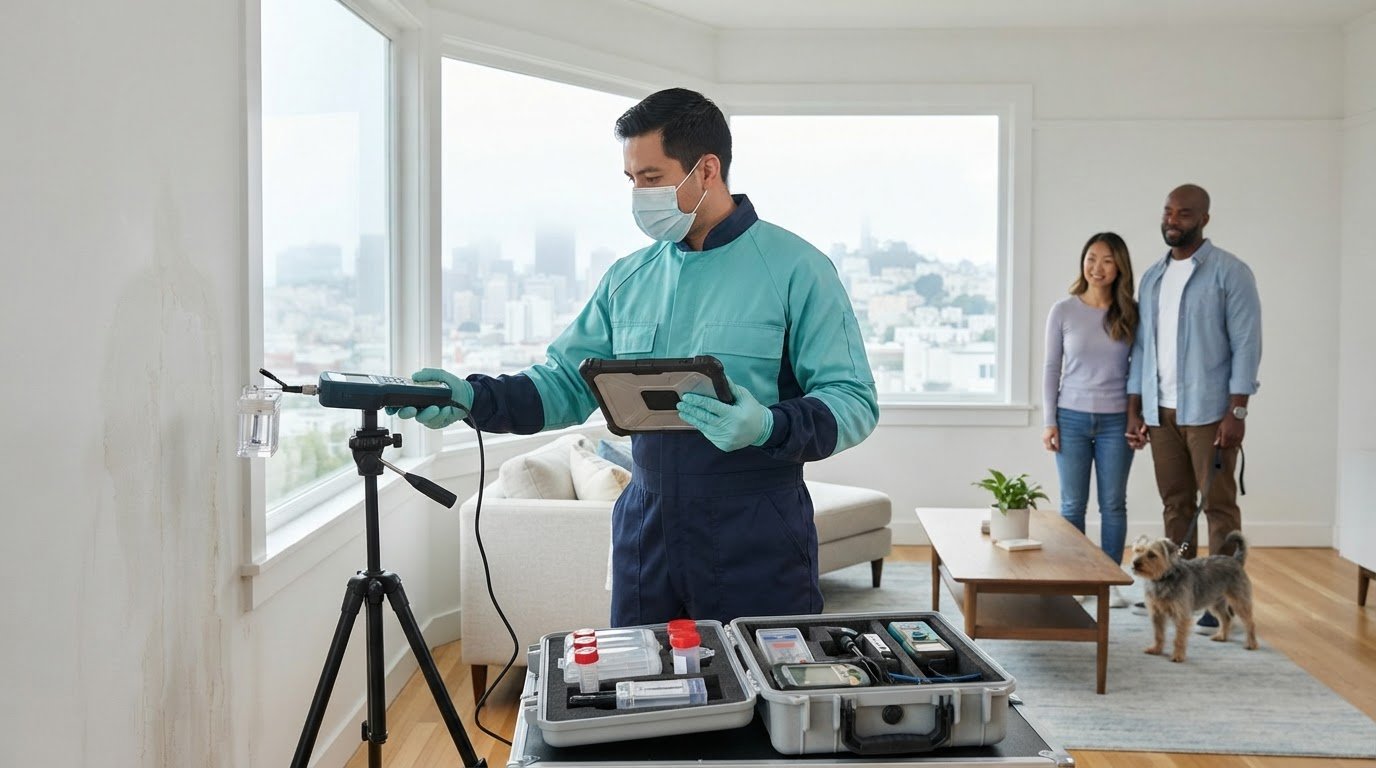

What if the very thing that makes San Francisco iconic, our rolling coastal fog and persistent marine layer, is silently compromising the health of your home? Living in the Bay Area means contending with high humidity that often leads to substandard building conditions as defined by California health codes. If you've spotted dark spots or smelled a musty odor, you're likely searching for effective mold remediation San Francisco homeowners can trust to be both thorough and safe.
It's stressful to worry about toxic spores affecting your family's health, especially since dampness and mold are linked to 21% of asthma cases in the U.S. Traditional solutions often involve tearing out walls and weeks of invasive construction, but you don't have to choose between a moldy home and a massive renovation project. You can eliminate these environmental hazards and restore your indoor air quality using a science-based approach that skips the demolition and toxic chemicals. We'll explain how a clinical, non-invasive process provides a permanent path to a healthy living space without the need for a general contractor.
Key Takeaways
- Understand how San Francisco’s unique microclimates and historic Victorian architecture create specific moisture vulnerabilities that fuel mold growth.
- Learn the critical distinction between physical mold removal and a systemic remediation approach that targets airborne spores and surface contamination.
- Discover how dry fog technology enables professional mold remediation san francisco homeowners can rely on to treat hidden areas without invasive demolition.
- Identify why bathrooms and attics are high-risk zones in the Bay Area and how specialized treatment protocols address these specific environments.
- Explore the benefits of a clinical, non-toxic approach that prioritizes indoor air quality and long-term health over traditional construction-heavy methods.
The San Francisco Mold Challenge: Climate and Architecture
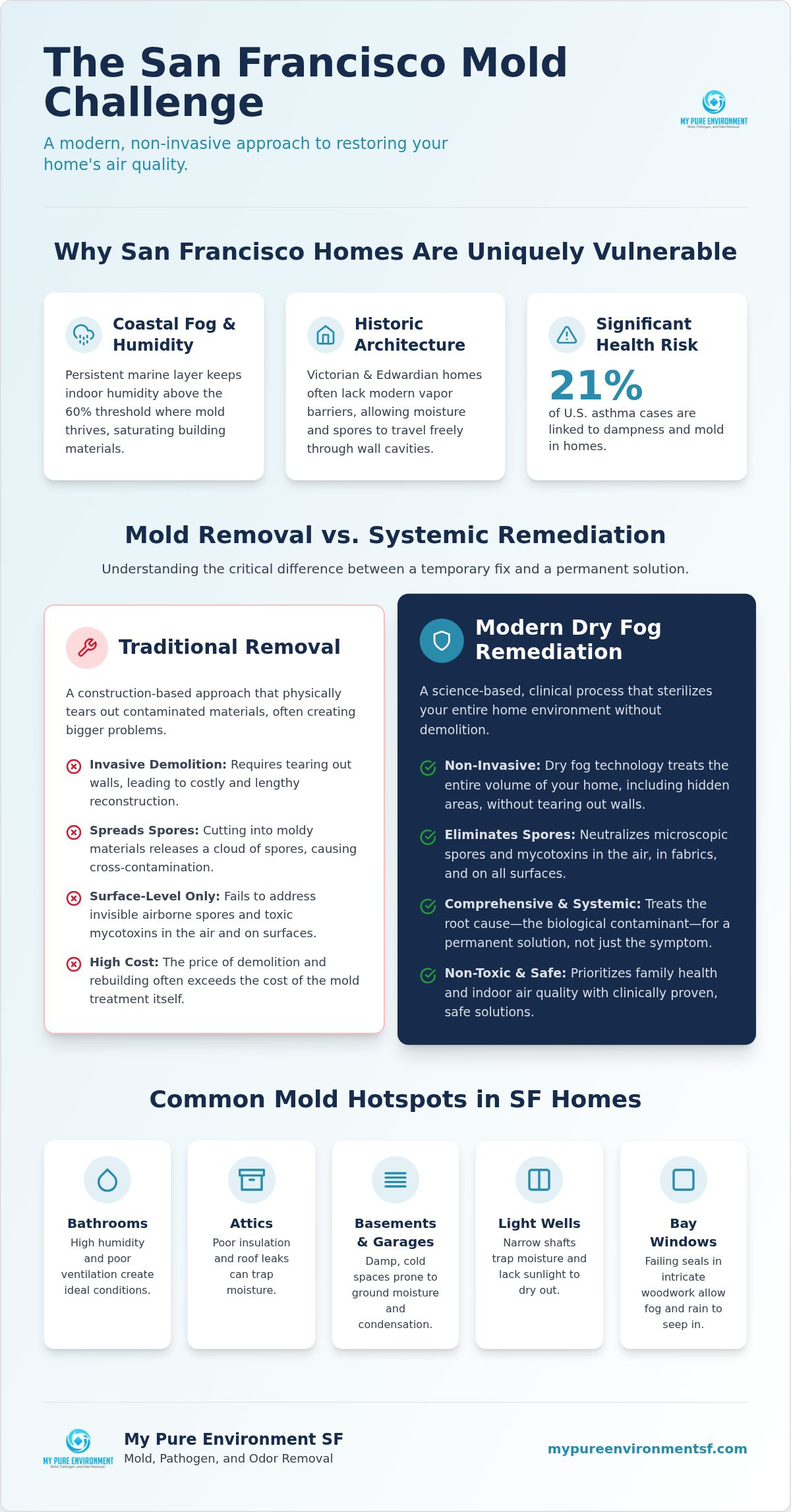
San Francisco's geography creates a unique set of environmental challenges for property owners. While inland California cities enjoy dry heat that naturally desiccates organic materials, "The City" contends with a persistent marine layer. This coastal fog doesn't just sit on the Golden Gate Bridge; it infiltrates building envelopes, maintaining indoor relative humidity levels that often exceed the 60% threshold where mold thrives. Effective mold remediation san francisco requires an understanding of these local atmospheric conditions. For those seeking a comprehensive overview of indoor mold, it's clear that moisture control is the primary pillar of prevention. In neighborhoods like the Sunset or the Richmond, the air is frequently saturated, meaning standard ventilation often brings in more moisture than it exhausts.
Microclimates and Indoor Humidity
The microclimates of San Francisco dictate the specific mold risks of a property. A home in Noe Valley might stay relatively dry, while a flat in the Fog Belt faces a constant influx of damp air. Dehumidification units often struggle to keep up because the building materials themselves, such as old wood and plaster, act like sponges. San Francisco building codes have evolved to require better mechanical ventilation, but many older units haven't been retrofitted. This lack of airflow, combined with the salt-laden sea spray that can degrade exterior seals, creates a perfect environment for fungal growth that requires a clinical approach to resolve.
Architectural Vulnerabilities in SF Homes
The city's historic Victorian and Edwardian architecture is world-famous, but these buildings weren't designed with modern vapor barriers. These structures often feature "balloon framing," which allows air and spores to move freely between floors through wall cavities. In the tightly packed row houses of neighborhoods like the Mission or Lower Haight, shared walls can mask leaks from a neighbor's plumbing, leading to hidden infestations. Common hotspots include:
- Light wells: These narrow shafts often trap moisture and lack the sunlight necessary to dry out after a heavy fog.
- Unconditioned basements: Many SF garages were originally dirt-floor crawl spaces that were later capped with thin concrete, leaving them prone to ground moisture.
- Bay windows: The intricate woodwork in historic windows often develops seal failures, allowing rain and fog to seep into the wall framing.
Basements and garages in San Francisco are particularly vulnerable. These spaces are often cold and damp, leading to condensation on the underside of the floorboards above. Without specialized mold remediation san francisco techniques that address these architectural quirks, mold often returns shortly after a surface-level cleaning. Addressing the root cause requires looking beyond the visible growth to the systemic moisture issues inherent in our coastal architecture.
Mold Remediation vs. Mold Removal: Understanding the Difference
Many property owners use the terms "removal" and "remediation" interchangeably, but in the context of professional mold remediation san francisco, the difference is fundamental. Mold removal refers specifically to the physical act of taking out infested materials. While this follows basic EPA guidelines on mold cleanup for certain porous items, it often fails to address the invisible threat. Simply tearing out a piece of drywall doesn't eliminate the microscopic spores or mycotoxins that have already settled into your carpets, upholstery, and HVAC system.
Mycotoxins are toxic secondary metabolites produced by fungi. Even if a colony is "dead" or dried out, these chemical compounds remain potent and can trigger health reactions. A purely construction-based approach treats mold like a broken pipe that just needs a patch. A science-based approach treats it like a biological contaminant that requires systemic sterilization.
The Problem with Traditional Removal
The standard "rip-and-tear" method often creates more problems than it solves. When a contractor cuts into a moldy wall without advanced containment, they release a cloud of spores that disperses throughout the home. This cross-contamination can lead to recurring growth in previously unaffected rooms. The high cost of traditional reconstruction often makes homeowners hesitant to act. Physical removal is certainly necessary when structural integrity is compromised by rot, but for many San Francisco homes, it is often an expensive and unnecessary overkill.
A Systemic Remediation Approach
True remediation focuses on the "roots" of the mold, known as hyphae, which can penetrate deep into building materials without being visible to the naked eye. Instead of just focusing on the spot on the wall, a systemic approach treats the entire air volume of the property. This ensures that every cubic inch of space is returned to a healthy state. Remediation is the restoration of fungal ecology to safe levels.
By shifting the focus from demolition to air purity, you can achieve a mold-free environment through professional mold remediation san francisco without the dust and debris of a major construction project. For those interested in a clinical alternative to messy reconstruction, exploring comprehensive air quality solutions is the most effective path forward. This methodical process ensures that the underlying biological issue is resolved, providing peace of mind for families concerned about long-term indoor health.
Non-Invasive Remediation: Dry Fog vs. Traditional Demolition
Traditional demolition methods treat mold like a localized stain, but science tells us it is a systemic airborne issue. When you choose professional mold remediation san francisco, the goal is to neutralize the entire environment rather than just the visible evidence. Dry fog technology represents the pinnacle of this clinical approach, offering a way to reach every corner of a property without swinging a single hammer. This method is particularly effective in our local climate, where moisture often finds its way into the smallest structural gaps.
The Science of Dry Fog
The efficacy of dry fog lies in its particle size. By creating a mist where every droplet is smaller than 8 microns, the sterilant behaves more like a gas than a liquid. This "dry" nature is critical; it allows the treatment to penetrate porous surfaces like drywall, wood framing, and even upholstery without leaving behind any residue or moisture. Unlike traditional wet misting, which can saturate materials and inadvertently trigger more growth, dry fog remains suspended in the air long enough to neutralize spores and mycotoxins in the most inaccessible areas. This is particularly valuable for San Francisco's complex architectural layouts, where mold often hides in narrow wall cavities or behind ornate Victorian trim.
Comparing the Disruption
The most significant difference between these two methods is the impact on your daily life. Traditional remediation often requires families to vacate their homes for days or weeks while contractors tear out walls and create clouds of hazardous dust. The subsequent reconstruction phase involves hiring a general contractor, buying new materials, and dealing with the noise of a construction site. In contrast, dry fog remediation typically takes only a few hours. Because there is no demolition, there is no need for expensive rebuilding. This approach preserves the structural integrity of historic homes, which is a major concern for owners of older properties in "The City."
By following CDC mold cleanup recommendations for safety and focusing on non-toxic agents, this process remains safe for children, pets, and individuals with respiratory sensitivities. The result is a home that is clinically clean and ready for re-entry the same day, providing a cost-effective alternative that prioritizes your family's health and peace of mind. Choosing mold remediation san francisco that utilizes this technology ensures that your home is restored to a healthy state without the stress of a long-term construction project.
Specialized Mold Removal: Bathrooms, Attics, and Crawl Spaces
San Francisco's architectural density and age mean that moisture often congregates in specific, high-risk zones. While systemic air treatment is essential for a healthy home, understanding the unique dynamics of bathrooms, attics, and crawl spaces is key to long-term success. Professional mold remediation san francisco must account for how these specific areas interact with the rest of the property's ecology. When a problem is localized in these zones, it often acts as a reservoir, continually seeding the rest of the living space with spores.
Bathroom Mold Prevention and Removal
Bathrooms are the primary site for fungal growth in humid SF neighborhoods like the Richmond or Sunset. Many older flats have windowless bathrooms that rely on outdated or non-existent exhaust fans. You might notice dark spots on the ceiling or a lingering musty scent behind the vanity. It's a common mistake to use bleach on these surfaces. Bleach is mostly water; while it may remove the surface pigment, the moisture actually feeds the underlying roots in porous materials like drywall or grout. Effective Bathroom Mold Removal requires a process that neutralizes the colony at a cellular level without saturating the material further.
Protecting Your Attic and Crawl Space
Attics and crawl spaces are often overlooked until a problem becomes severe. In San Francisco's older housing stock, poor insulation and inadequate ventilation create a stagnant environment where roof leaks go unnoticed for months. This leads to an attic mold crisis that compromises both the wood framing and the insulation. Crawl spaces are equally problematic due to the "stack effect." This phenomenon occurs when warm air rises through the home, creating a vacuum that pulls cool, damp, spore-laden air from the crawl space up into your living areas. This means that a problem under your floorboards is directly impacting the air you breathe in your bedroom.
Protecting these structural members requires more than a surface scrub. It involves treating the wooden beams and insulation to ensure the air being pulled into your home is pure. If you're concerned about hidden growth in these difficult-to-reach areas, you can schedule a professional Attic Mold Remediation or crawl space assessment to identify the source. By addressing these specialized zones with a non-invasive, clinical approach, you protect the health of your entire household. This targeted strategy ensures that mold remediation san francisco homeowners receive is both comprehensive and permanent, preventing the cycle of regrowth that often follows less thorough methods.
The My Pure Environment SF Standard: Clinical Air Purity
Choosing a specialist over a general restoration company ensures that your project is handled with clinical precision. Most restoration firms operate as generalists; they treat mold as a construction problem to be demolished and rebuilt. Our approach to mold remediation san francisco is fundamentally different. We focus exclusively on the science of sterilization and indoor air quality. Because we don't offer general construction or rebuilding services, there is no conflict of interest in our assessments. We're not looking for excuses to tear down your walls; we're looking for the most effective, non-invasive path to a healthy environment.
This commitment to high-level compliance is rooted in our work with the professional cannabis industry. In commercial cultivation facilities, fungal contamination isn't just a nuisance; it's a threat to the entire business. We apply those same rigorous, zero-tolerance standards to every residential project. If our protocols can protect a sensitive commercial crop, they can certainly protect your family. We leverage our deep understanding of the 2025 California Building Codes and San Francisco Health Code Article 11 to ensure every project meets local safety mandates.
A Focus on Indoor Air Quality (IAQ)
The goal of our process is to restore the biological balance of your home. We don't just guess if the job is done; we prove it through post-remediation testing. This clinical data provides the peace of mind that your indoor air is safe for occupancy. By identifying specific toxic strains and their concentrations, we can tailor our dry fog application to provide the most effective results. It's a methodical progression from detection to total elimination, ensuring that your home's air volume is purified at a cellular level.
Serving the SF Community and Beyond
We're proud to be a local partner for property managers, real estate agents, and homeowners across the Bay Area. Our non-invasive methods are particularly valuable during real estate transactions where time and structural integrity are paramount. Beyond residential homes, we continue to provide the specialized mold remediation san francisco businesses and cannabis facilities need to maintain strict regulatory compliance. If you're ready to address a moisture issue with a science-based, clinical approach, Schedule your professional mold inspection today and take the first step toward a healthier indoor environment.
Restoring Your Home’s Environmental Health
Living in San Francisco shouldn't mean compromising on the air you breathe. By shifting from traditional "rip-and-tear" methods to a clinical, science-based approach, you can protect your family's health and your property's value. We've explored how our unique coastal climate and historic architecture demand a specialized response. Our non-invasive dry fog technology reaches the hidden spaces where moisture lingers, providing a comprehensive solution without the chaos of a construction site.
Whether you're dealing with a persistent bathroom issue or need a whole-home assessment, our expertise in high-compliance cannabis facility remediation ensures your living space meets the highest standards of purity. We focus exclusively on air quality and mold elimination, providing unbiased results you can trust. It's time to stop worrying about recurring growth and start enjoying a truly sterilized environment.
If you're ready to secure your indoor air quality, Get a Pure Home: Book Your SF Mold Inspection today. Choosing professional mold remediation san francisco residents trust means prioritizing long-term wellness and scientific accuracy. You deserve a home that feels as fresh as the Pacific breeze, and we're here to help you achieve it.
Frequently Asked Questions
How long does the mold remediation process take in San Francisco?
Most non-invasive mold remediation projects in San Francisco are completed within a single day. The actual dry fog application typically takes only a few hours, depending on the square footage and the complexity of the building's layout. This is a significant time savings compared to traditional demolition-based methods, which often require several days or even weeks of reconstruction after the initial removal is finished.
Is the dry fog used in mold remediation safe for pets and children?
Yes, the dry fog technology is designed to be safe for all occupants, including pets and children. We use eco-friendly, EPA-approved sterilants that leave no toxic residue on surfaces or in the air. Because the particles are so small, they dissipate quickly after the treatment is complete. Families can typically return to their homes the same day with full confidence in the safety of their indoor environment.
Do I need to move out of my house during the remediation?
You only need to vacate the property for a few hours while the treatment is being applied and the fog is settling. There is no need for long-term displacement or hotel stays because our process doesn't involve tearing out walls or creating hazardous dust. Once the technician gives the all-clear, you can return to your normal routine immediately. This makes the process much less disruptive than traditional restoration services.
Can mold return after professional remediation in SF’s humid climate?
Mold can return if the underlying moisture source isn't addressed, but professional mold remediation san francisco provides a sterile baseline. Our process eliminates existing colonies and airborne spores throughout the home. To prevent future growth in the Bay Area's humid climate, it's essential to maintain proper ventilation and repair any leaks. We provide guidance on managing these environmental factors to ensure your results are permanent.
What is the difference between a mold inspection and a mold remediation?
A mold inspection is the diagnostic phase where a specialist identifies the location, type, and extent of the fungal growth through visual assessment and air sampling. Mold remediation is the actual treatment phase where the biological contaminants are neutralized and removed. Think of the inspection as the medical exam and the remediation as the treatment that restores the building's health to safe, clinical levels.
Does insurance typically cover mold remediation in San Francisco?
Insurance coverage for mold remediation san francisco depends largely on the root cause of the moisture. Most policies cover mold if it resulted from a "sudden and accidental" event, like a burst pipe. Between 2019 and 2023, water damage and mold accounted for nearly 29% of homeowner insurance losses, with average claims around $15,400. However, mold from long-term humidity or lack of maintenance is often excluded from standard policies.
How can I tell if the mold in my bathroom is toxic?
You can't determine if mold is toxic simply by looking at its color or texture. While many people associate "black mold" with toxicity, many different species can appear dark but have varying health effects. The only scientifically accurate way to identify toxic strains is through professional laboratory testing of air or surface samples. This clinical data helps us understand the specific risks and tailor the remediation process accordingly.
Why shouldn’t I just use bleach on the mold myself?
Bleach is ineffective on porous materials like drywall and wood because its chemical structure prevents it from reaching the mold's root system. Since bleach is roughly 90% water, it can actually feed the fungi deep inside the material while only removing the surface pigment. This often leads to a cycle of rapid regrowth. Professional remediation uses specialized agents that penetrate the material to ensure the colony is neutralized at its source.