

Could black mold symptoms point to a specific kind of mold? Not by themselves. Sneezing, a runny nose, irritated eyes, coughing, or a skin rash can occur with mold exposure, but they can also have other causes. A dark color alone can’t show whether growth is toxic or identify a species.
If you’re noticing symptoms at home, it’s understandable to wonder whether mold is affecting your health. This guide explains which symptoms may be associated with indoor mold, why they can’t confirm the cause, and when to seek medical advice. If you’re having difficulty breathing, seek urgent medical care.
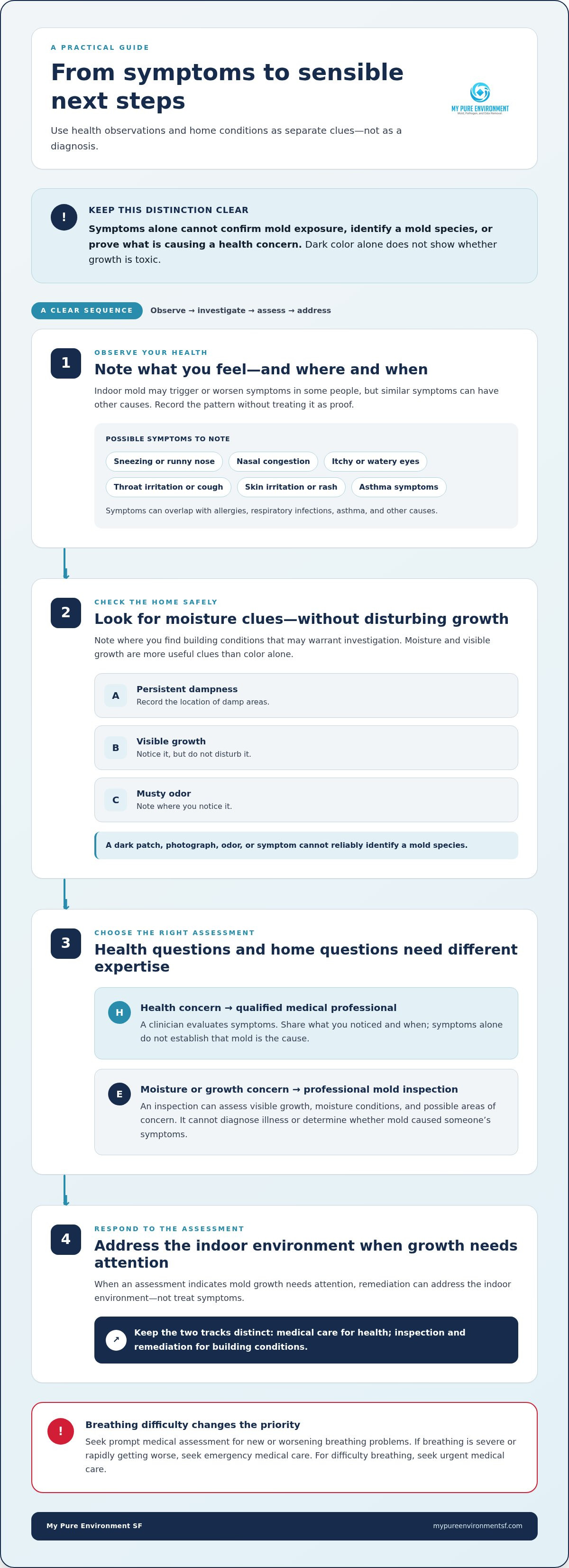
To decide what to do next, note your symptoms and where they occur, then look for signs of moisture or visible growth without disturbing it. A professional mold inspection can assess indoor conditions, not diagnose illness. Moisture and visible growth are more useful clues for investigating a home than color alone.
Key Takeaways
- Common black mold symptoms may involve the nose, eyes, throat, skin, or asthma, and can vary from person to person.
- Note where and when symptoms occur, along with any damp areas, visible growth, or musty odors, to help guide next steps.
- Seek medical advice for health concerns; symptoms alone can’t establish that mold is the cause.
- A mold inspection can assess visible growth, moisture conditions, and possible areas of concern without diagnosing illness.
- When assessment indicates mold growth needs attention, remediation can address the indoor environment rather than treat symptoms.
What are black mold symptoms, and what can they tell you?
Black mold symptoms are possible health responses associated with indoor mold exposure, not proof that a particular mold is present or causing a health concern. Irritation or respiratory discomfort can have many explanations, so symptoms are a reason to consider the full picture, not a way to diagnose yourself or your home.
Symptoms alone cannot confirm mold exposure or identify a mold species. A health assessment and an indoor environmental assessment answer different questions. A qualified medical professional evaluates a person’s symptoms, while a mold inspection investigates building conditions such as visible growth and moisture.
What people mean by “black mold”
“Black mold” is a common description based on appearance, not a reliable identification of a species or its toxicity. Dark-colored indoor growth can belong to different types of mold, and a patch’s color doesn’t establish what it is.
Stachybotrys chartarum is one mold often associated with the term. That association doesn’t mean every dark patch is this species. A photograph, color, odor, or person’s symptoms can’t reliably identify mold. If identification is relevant to an investigation, it requires appropriate assessment rather than visual guesswork.
Why symptoms do not prove the source
Mold-related effects can overlap with common health conditions. Nasal or eye irritation, coughing, and breathing symptoms may also occur with allergies, respiratory infections, asthma, or other causes. Even if symptoms seem to worsen in a particular room, that pattern alone doesn’t show what’s causing them.
Pay attention to your health, but leave diagnosis to a qualified medical professional. An environmental assessment can look for signs of mold or moisture that can support its growth; it can’t determine whether mold caused someone’s symptoms. Keeping these questions separate can help avoid premature conclusions and unnecessary alarm.
In practical terms, treat symptoms as health information to discuss with a clinician, and treat dampness or visible growth as building conditions to investigate. Note where and when you notice each one. This makes it easier to choose sensible next steps without relying on the label “black mold” or trying to diagnose the source by appearance.
Which black mold symptoms are commonly reported?
Indoor mold exposure may trigger or worsen symptoms in some people, but responses differ. The U.S. Environmental Protection Agency lists allergic reactions and irritation among possible effects. Symptoms can also have causes unrelated to mold, so a list of symptoms can’t establish what’s affecting you.
Nasal congestion, sneezing, itchy or watery eyes, throat irritation, coughing, skin irritation, and asthma symptoms are commonly reported categories, but none is specific to mold. Notice what you’re experiencing without treating it as a diagnosis.
Respiratory, nasal, and eye symptoms
Possible nasal symptoms include sneezing and a runny or congested nose. Irritated, red, itchy, or watery eyes and a scratchy throat may also occur. Coughing or other respiratory irritation can be reported as well. These effects overlap with common conditions, including seasonal allergies and respiratory infections, so the symptom itself doesn’t identify the cause.
People with allergies or asthma may be more sensitive to indoor irritants, and mold exposure may worsen asthma symptoms for some. If you have a known respiratory condition, follow your clinician’s advice and pay attention to changes in how you feel. Don’t assume that a particular room or visible patch is responsible.
Skin symptoms and asthma concerns
Skin irritation or a rash may be associated with mold exposure, but rashes have many possible causes. A healthcare professional can help assess a skin concern in context, especially if it persists, worsens, or causes significant discomfort.
Wheezing or breathing difficulty deserves particular attention. Seek prompt medical assessment for new or worsening breathing problems. If breathing is severe or rapidly getting worse, seek emergency medical care. An indoor mold inspection can examine building conditions, but it can’t evaluate or diagnose a person’s health.
If symptoms seem to change between locations, note where and when they occur and share that information with a healthcare professional. This observation may be useful, but it still doesn’t prove a connection to mold. Separately, persistent dampness or visible growth can be investigated through professional mold testing and inspection, which focuses on environmental conditions rather than medical conclusions.
Does black mold cause symptoms, and how can you tell?
Mold exposure can cause or worsen symptoms in some people, but a symptom pattern alone can’t show whether mold is responsible. Congestion or coughing, for example, may occur alongside indoor mold but can also have other causes. Even if symptoms seem to ease when you leave a room, record that change as a clue, not proof of what triggered them.
Look at building conditions as well as how you feel. Persistent dampness, visible growth, or a musty odor can support investigating a moisture or mold concern. Note the location of these signs and whether symptoms appear to change in the same places. Those observations can guide follow-up, but they don’t establish that mold caused a health problem.
Mold color, species, and health risk are not interchangeable
A dark patch can’t be identified reliably by color, and color doesn’t establish its health risk. Stachybotrys chartarum is often associated with the term “black mold,” but not every dark-colored growth is that species. Nor does the label “toxic mold” diagnose a person’s symptoms or determine the risk of a particular exposure.
Potential effects depend on circumstances such as the presence and extent of mold, exposure conditions, and a person’s individual sensitivity. There isn’t one risk level that can be assigned to every dark patch or every person. Avoid relying on photographs, odor, or symptoms to identify a mold type.
When to seek medical advice
For persistent, worsening, or concerning symptoms, contact a qualified healthcare professional. They can assess your health and consider possible causes; an indoor environmental inspection can’t replace that clinical evaluation. If you have asthma or another respiratory condition, follow your clinician’s guidance if symptoms change.
Seek urgent medical care for severe breathing difficulty or other emergency symptoms. Don’t wait for an inspection to address an urgent health concern.
Keep the two investigations distinct: medical care evaluates the person, while professional mold testing and inspection assesses visible growth, moisture conditions, and areas of concern in the building. These steps can help you respond thoughtfully without treating black mold symptoms, a musty smell, or a dark surface as proof of causation.
What should you do if you suspect black mold at home?
Start with conditions you can observe, not a guess about the mold’s identity. Persistent dampness, visible growth, or a musty odor can justify further attention, but none confirms a particular species or explains someone’s symptoms. In San Francisco, as anywhere, moisture intrusion or ongoing dampness is a reason to investigate the building, not proof that mold is present.
Safe first steps for residents
Keep a simple record of what you observe. Note where you see moisture or suspected growth, when it appeared, and whether symptoms seem to change by location. Photos taken from a safe distance can document visible conditions, but they can’t identify a mold species or establish a health cause.
If an area is extensive, hidden, or likely to spread when disturbed, don’t scrape, dry-brush, or otherwise disturb it. Avoid trying to identify growth by color or odor. For an active leak or another moisture source, arrange appropriate building maintenance to address the cause. Drying and moisture control matter because ongoing dampness can allow mold growth to continue.
Keep health decisions separate from home observations. If symptoms are persistent, worsening, or concerning, seek advice from a qualified healthcare professional. Severe breathing difficulty or another emergency symptom requires urgent medical care.
When environmental testing or inspection may help
A professional mold inspection can help when visible growth, recurring moisture, or a persistent musty odor raises questions about indoor conditions. The assessment can investigate areas of concern and moisture conditions. Sampling may be one tool in that process, but a result can’t determine whether mold caused a person’s symptoms or provide a medical diagnosis.
For an overview of how environmental assessment works, read a San Francisco mold testing and inspection guide. It can help you understand what an inspection may clarify and how findings relate to possible next steps.
When suspected growth or moisture is difficult to assess on your own, schedule professional mold testing and inspection to investigate indoor conditions. The goal is to understand what’s happening in the building, while health concerns remain with a medical professional.
How professional mold inspection and remediation can help
When visible growth, recurring moisture, or a persistent musty odor raises concern, a professional assessment can clarify what’s happening in the building. It focuses on environmental conditions, not on diagnosing the cause of black mold symptoms. Inspection findings can guide property-related next steps, while health concerns belong with a qualified medical professional.
What an environmental assessment can clarify
An inspection can assess visible growth, moisture conditions, and areas that may warrant further investigation. Depending on the property and concerns, testing or sampling may be considered as part of the assessment. No single observation or sample tells the whole story, and environmental findings can’t prove that mold caused a person’s symptoms.
For broader context, an indoor air quality guide can explain how building conditions relate to the indoor environment. A professional mold remediation guide can also help you understand what remediation may involve when an assessment indicates mold growth needs attention.
A measured next step for San Francisco properties
Professional inspection is useful when you find recurring dampness, visible growth, or an odor that persists despite routine cleaning and ventilation. If an assessment identifies mold growth that should be addressed, remediation focuses on that growth and relevant environmental conditions. The appropriate approach depends on the building and project scope.
Remediation is not medical treatment, and it can’t guarantee that a person’s symptoms will improve. Its purpose is to address mold-related conditions in the property. Findings and the work required can vary, so avoid assuming a particular result or timeline before the conditions are assessed.
For San Francisco property owners, a calm first step is to understand indoor conditions before deciding what action is needed. My Pure Environment SF provides professional mold inspection, testing, remediation, and indoor air quality improvement. These services can help investigate suspected mold concerns and address mold growth in your property.
Take the Next Step With Confidence
Black mold symptoms can be unsettling, but they can’t identify a mold species or prove that indoor mold is causing a health concern. Symptoms may have several causes, so consult a qualified healthcare professional about persistent, worsening, or concerning health changes.
For the home, focus on observable conditions: recurring moisture, visible growth, or a musty odor. These clues can help determine whether an environmental assessment is appropriate, but they don’t establish a medical diagnosis. Keep the questions distinct: clinicians assess health, while mold inspection investigates building conditions.
San Francisco property owners can use professional mold testing and inspection, mold remediation, and indoor air quality improvement from My Pure Environment SF. Explore professional mold inspection and remediation in San Francisco to learn about practical options for addressing suspected mold conditions. With clear information and the right assessment, you can take a measured next step for your property.
Frequently Asked Questions
Can black mold cause coughing or breathing problems?
Indoor mold may trigger or worsen respiratory symptoms in some people, particularly those with allergies or asthma, but coughing and breathing problems have many possible causes. Black mold symptoms can’t identify a mold species or prove that someone was exposed. If symptoms persist or worsen, consult a qualified healthcare professional. A mold inspection addresses conditions in the building; it doesn’t diagnose a person’s health.
What are the first signs of black mold exposure?
There’s no single symptom pattern that confirms mold exposure. Some people may experience nasal irritation, coughing, itchy eyes, or skin irritation, but these symptoms are nonspecific and can have other causes. Visible growth, recurring moisture, or a musty odor may justify investigating the home’s conditions. None of these signs alone identifies a mold species or establishes that mold is causing an illness.
Can you identify black mold by its color?
No. A dark color isn’t enough to identify a mold species or determine health risk. Different indoor molds can look similar, and their appearance may vary with the surface and conditions. Don’t touch, scrape, or disturb suspected growth to try to identify it. An environmental professional can assess the building, while a qualified medical professional evaluates health concerns. The two assessments serve different purposes.
How long does it take for black mold symptoms to appear?
There’s no reliable universal timeline for symptoms after possible mold exposure. Individual responses vary, and symptoms such as coughing or irritation can also arise from allergies, infections, or other irritants. Timing alone can’t confirm exposure or identify its source. If symptoms are persistent, worsening, or concerning, seek medical guidance rather than using when they began to diagnose mold exposure.
Can black mold symptoms go away after leaving the house?
Symptoms may change after someone leaves an environment, but that change alone doesn’t prove mold caused them. Other health and environmental factors can affect how a person feels, and responses differ. Discuss ongoing concerns with a medical professional. Separately, if the home has recurring moisture, visible growth, or a persistent musty odor, an environmental assessment can investigate those building conditions.
Should I get a mold inspection if I have symptoms?
Symptoms alone don’t establish that indoor mold is present or that an inspection is needed. An inspection can help investigate visible growth, recurring moisture, or a persistent musty odor. Medical evaluation addresses health concerns; environmental assessment focuses on the building. San Francisco residents can learn more in this San Francisco mold testing guide, which explains how testing and inspection can investigate suspected indoor conditions.
When should I seek medical help for symptoms I think are related to mold?
Contact a qualified medical professional about persistent, worsening, or concerning symptoms, especially if you have asthma or another relevant health condition. Severe breathing difficulty or another emergency symptom warrants urgent medical care. Don’t rely on an online article or a mold inspection to diagnose or treat a health condition. An inspection can assess indoor conditions, but it can’t determine what’s causing your symptoms.