

If you’re wondering “what does a mold inspector look for sf,” the answer goes beyond checking walls for discoloration. A careful inspection follows visible and moisture-related clues to understand where mold may be growing and what conditions could allow it to persist.
A musty odor or stain can raise questions without proving there is hidden mold. In San Francisco homes, an inspection may consider bathrooms, plumbing, HVAC systems, windows, and other places where dampness can go unnoticed. The goal is to document observed conditions and identify which concerns may need further investigation, rather than treating every mark as proof of a larger problem.
This guide explains what an inspector may examine, how moisture readings and visual observations fit together, and when mold testing may add useful information. You’ll also learn what inspection findings can and can’t tell you, so you can understand the results and consider practical next steps without jumping to conclusions.
Key Takeaways
- Learn what does a mold inspector look for sf, from visible growth and staining to signs of recurring dampness.
- See how a property’s moisture history and accessible areas can help focus an inspection on possible concerns.
- Understand how visual observations, moisture assessment, and sampling answer different questions, and why testing isn’t automatic.
- Prepare useful details about when odors, leaks, staining, or condensation began and how they change over time.
- Use documented findings to understand whether monitoring, further assessment, testing, or targeted remediation may be an appropriate next step.
What Does a Mold Inspector Look for in a San Francisco Property?
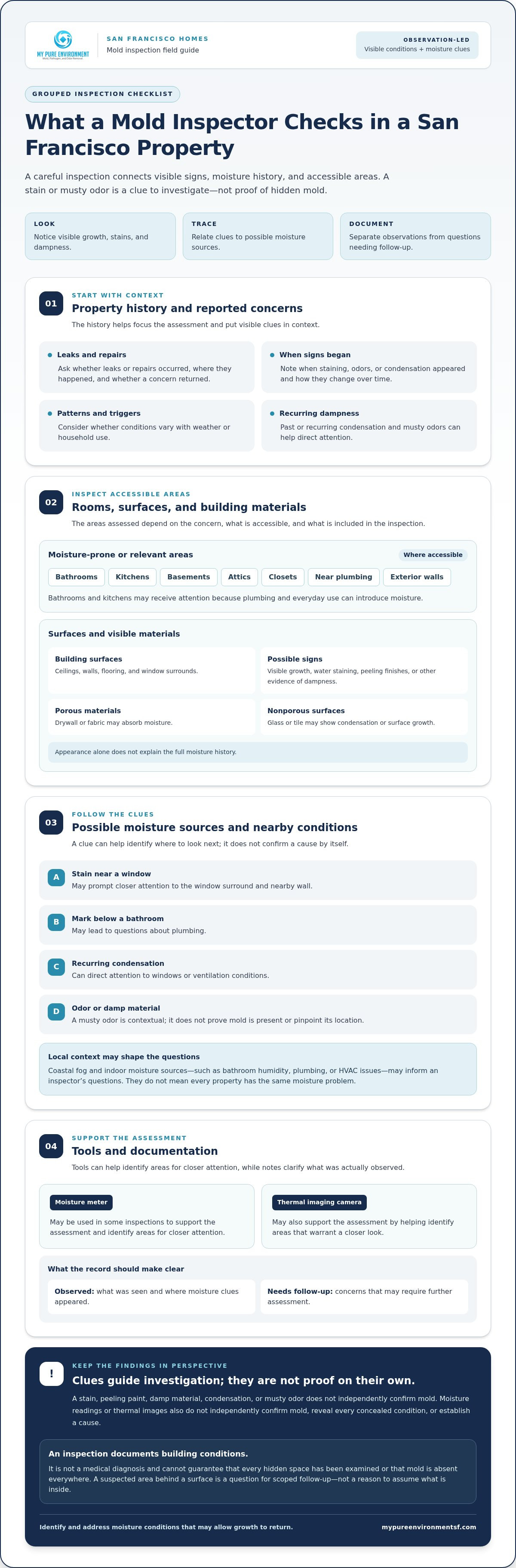
A mold inspection is a structured assessment of visible conditions and moisture-related clues that may point to mold growth. An inspector looks for visible growth, water staining, condensation, musty odors, and signs of recurring dampness. They then consider how those observations may relate to possible moisture sources. This mold inspection overview describes the general process, which can include visual assessment and further investigation based on the concern.
If you’re asking “what does a mold inspector look for sf,” the answer depends on the property and the inspection’s scope. An inspection documents accessible areas and observed conditions. It can’t guarantee that every hidden space has been examined or that mold is absent everywhere.
Which rooms and surfaces may an inspector examine?
Bathrooms and kitchens often receive attention because plumbing and everyday use can introduce moisture. An inspector may also examine basements, attics, closets, and areas near plumbing or exterior walls. Relevant surfaces can include ceilings, walls, flooring, window surrounds, and visible building materials. Look for signs such as growth, staining, peeling finishes, or other evidence of dampness.
Your account of the property’s history helps put these observations in context. The inspector may ask about past leaks, recurring condensation, musty odors, or previous repairs, including when an issue appeared and whether it returned. The areas assessed depend on what is accessible and included in the inspection.
Why moisture clues matter as much as visible mold
A stain, peeling paint, damp material, or condensation on a window doesn’t confirm mold on its own. These clues can help identify where moisture may be present or may have occurred, directing attention to nearby surfaces and possible contributing conditions. The aim is to connect the observations, not treat one mark as a complete diagnosis.
In San Francisco, coastal fog and indoor moisture sources, such as bathroom humidity, plumbing, or HVAC issues, may inform an inspector’s questions. They don’t mean every property has the same moisture problem. For more context on when sampling may help answer a specific concern, see the San Francisco mold testing guide.
An inspection documents building conditions. It isn’t a medical diagnosis or a guarantee that mold is absent from every inaccessible area. Its value is in clarifying what was observed, where moisture clues appeared, and what next step may be appropriate.
How Inspectors Trace Moisture and Look for Hidden Mold
A suspicious mark is a starting point, not a conclusion. A careful assessment gathers the property’s history, examines accessible areas, follows moisture clues to possible sources, and documents the observations. This process helps answer what does a mold inspector look for sf without treating an odor or stain as proof of hidden growth.
- Gather history. The inspector asks when staining, odors, or condensation began, whether they change with weather or household use, and whether leaks or repairs have occurred.
- Inspect accessible areas. Visible surfaces and relevant building materials are assessed in light of the reported concern.
- Follow moisture clues. A stain near a window may prompt closer attention to the window surround and nearby wall. A mark below a bathroom may lead to questions about plumbing, while recurring condensation may raise questions about ventilation.
- Document observations. Notes distinguish what was seen from what may need further assessment.
A moisture meter or thermal imaging camera may be used in some inspections to support the assessment. These tools can help identify areas for closer attention, but readings or images don’t independently confirm mold, reveal every concealed condition, or establish a cause on their own. A suspected area behind a surface is a question for scoped follow-up, not a reason to assume what is inside.
How inspectors interpret stains, odors, and condensation
A water stain can direct attention to nearby plumbing, windows, a roof area, or another possible source, depending on its location and history. A musty odor is a contextual clue. It may help identify where to investigate, but it doesn’t prove mold is present or pinpoint its location. Recurring condensation can also direct attention to windows or ventilation conditions. The EPA mold guidelines provide broader information about mold, inspection, and response.
What ventilation and materials can reveal
Where accessible and relevant, an inspector may assess HVAC components, bathroom exhaust, windows, and surfaces where moisture can collect. Different materials can show different signs. Porous materials such as drywall or fabric may absorb moisture, while nonporous surfaces such as glass or tile may show condensation or surface growth. Neither appearance alone explains the full moisture history. For more on airborne concerns, see this San Francisco mold and indoor air quality guide.
Recurring mold concerns are best evaluated by identifying and addressing the moisture conditions that allow growth to return. My Pure Environment SF provides mold inspection and testing in San Francisco to help clarify what the observed evidence supports. More information about San Francisco mold inspection and testing is available here.
Visual Inspection vs. Mold Testing: What Each Can Tell You
Inspection and testing are related, but they answer different questions. A visual inspection documents observable conditions, while moisture assessment helps identify damp areas that may need attention. Sampling analyzes material or air collected from a particular location. For anyone asking what does a mold inspector look for sf, the key distinction is that sampling can add information, but it doesn’t replace an assessment of the building and its moisture conditions.
| Assessment | Purpose and output | Limitations |
|---|---|---|
| Visual inspection | Documents visible growth, staining, odors, and other observable conditions in assessed areas. | Doesn’t reveal every concealed area or identify mold types from appearance alone. |
| Moisture assessment | Checks for signs of dampness and helps focus attention on possible moisture concerns. | Indicates conditions at assessed locations, not necessarily their cause or full extent. |
| Sampling | Collects an air or surface sample for analysis to help answer a defined question. | Represents the sampled location and conditions; it can’t establish that an entire building is mold-free. |
Inspection findings and sample results answer related but different questions. One describes observed building conditions; the other reports what was detected in a specific sample. Interpret a result in context, alongside the sample location, inspection observations, and reason for testing.
When can mold sampling add useful information?
Sampling may help clarify an uncertain finding or support a focused investigation when observations alone don’t resolve a specific question. The inspector should explain why a sample is being taken, what it can establish, and how the result relates to the concern. No single test identifies every possible mold source, measures all exposure, or determines whether a person’s symptoms are caused by a building.
What an inspection or test cannot establish
An inspection is not a medical diagnosis, and its findings can’t attribute an individual’s symptoms to a property. A limited inspection may also leave concealed or inaccessible areas unevaluated. A negative result from one sample applies to that sample and its collection conditions, not every room or surface. For property-purchase context, see this San Francisco home buyer’s mold inspection guide.
Testing is most useful when it serves a clear purpose. Documented observations and moisture clues can help determine whether sampling would add meaningful information or whether another next step is more appropriate.
How to Prepare for a Mold Inspection in San Francisco
A little preparation can help focus the inspection on the areas and patterns that concern you. If you’ve searched “what does a mold inspector look for sf,” sharing a clear history of what you’ve noticed can help connect visible conditions with possible moisture clues. San Francisco properties vary in age, layout, and repair history, so those details provide context, not proof of a mold problem.
Use this checklist to prepare:
- Make a brief timeline. Note when odors, staining, leaks, or condensation first appeared and whether they come and go or change with weather, ventilation, or household use.
- List the locations. Record the rooms and surfaces of concern, such as a window surround, bathroom ceiling, closet wall, or area near plumbing.
- Gather relevant history. If readily available, collect maintenance notes, information about past leaks, or records of previous repairs. Don’t delay an urgent safety decision while searching for paperwork.
- Describe what has changed. Mention whether a stain has spread, an odor is stronger at certain times, or condensation appears repeatedly in a particular location.
- Make relevant areas accessible. Clear ordinary obstructions from the areas of concern where practical, and point out locations that may need closer visual assessment.
- Write down your questions. Ask what observations mean, which moisture sources may be considered, whether sampling could answer a specific question, and how to interpret the findings.
Keep preparation non-invasive. Don’t scrape suspected growth, remove finishes, or open walls before the inspection. Disturbing a material can change the conditions being assessed and may create unnecessary exposure. Identify the location and describe what you’ve observed instead.
Property age, room layout, prior repairs, and maintenance history can help explain why a concern deserves attention, but none confirms mold by itself. Separate what you know, such as a past leak, from what you suspect, such as possible hidden growth. That distinction gives the inspection a clearer starting point.
My Pure Environment SF provides mold inspection in San Francisco. Information about the service is available at San Francisco mold inspection.
What Happens After a Mold Inspector Documents Findings?
After the inspection, the findings should help you understand what was observed and what may warrant follow-up. A useful report separates direct observations from possible explanations and recommendations. It should identify the areas assessed, note relevant moisture clues, explain any access or sampling limitations, and outline practical next steps based on the evidence.
How to understand inspection findings and recommendations
Read the report in layers. First, note the documented conditions, such as visible staining or dampness, and where they were observed. Then distinguish those facts from hypotheses about a possible moisture source. A suspected source is not a confirmed cause, especially if parts of the building weren’t accessible during the inspection.
Pay attention to the scope. The report should make clear which areas were assessed and whether access limitations or sampling choices affect what can be concluded. Moisture clues can help prioritize follow-up. A recurring damp area, for example, may call for further assessment of that location, while an isolated observation may support a different response. If a recommendation is unclear, ask how it relates to the documented findings.
When mold testing or remediation may be a next step
The appropriate next step depends on the inspection question, observed conditions, and available evidence. Monitoring may make sense when there’s a condition to track; further assessment may be useful if a relevant area couldn’t be evaluated. Testing can help answer a defined question about a sample, while targeted mold remediation may be appropriate when findings support addressing mold growth. A single clue doesn’t automatically mean testing or remediation is necessary.
My Pure Environment SF provides mold inspection and testing, along with mold remediation in San Francisco. Findings can help clarify whether testing may add useful information or whether remediation is a relevant response. The report should guide that decision without creating unnecessary alarm.
For information about mold inspection in San Francisco, visit My Pure Environment SF.
Use Inspection Findings to Choose a Clear Next Step
Understanding what does a mold inspector look for sf starts with seeing the inspection as an evidence-based assessment, not a guarantee about every hidden space. Inspectors consider visible conditions alongside moisture clues, then document what was assessed and where limitations apply.
Testing can add information when there’s a specific question to answer, but it isn’t automatically needed for every concern. Inspection findings help clarify whether monitoring, further assessment, sampling, or targeted remediation may be appropriate. Preparing a timeline of odors, leaks, staining, or condensation can also make the visit more focused.
My Pure Environment SF serves San Francisco with mold inspection and testing, mold remediation, and indoor air quality improvement. The right next step should reflect the observations and the concern at hand, without jumping to conclusions.
To discuss a mold concern in your San Francisco property, contact My Pure Environment SF about a mold inspection. Clear findings can help you decide what to do next.
Frequently Asked Questions
What does a mold inspector look for in a San Francisco home?
A mold inspector looks for visible growth and moisture-related clues that may help explain suspected mold. These can include water staining, damp materials, peeling finishes, condensation, and musty odors in areas such as bathrooms, attics, kitchens, or near plumbing and windows. For anyone searching “what does a mold inspector look for sf,” the key is that the assessment considers observed conditions and their possible moisture context, within the accessible areas and agreed scope.
Does a mold inspector check inside walls?
Not necessarily. A standard visual assessment focuses on accessible surfaces and doesn’t automatically involve opening walls or removing finishes. Staining, persistent odors, or moisture clues may raise a question about a concealed area, but they don’t prove what’s behind it. The inspector can document the concern and explain whether focused follow-up is appropriate. Avoid cutting into walls or disturbing suspected growth before the assessment, since that may change the area being evaluated.
Do mold inspectors always take air samples?
No. Air sampling isn’t automatically necessary for every mold concern. A visual inspection and moisture assessment may provide useful information when growth or dampness is observable. Sampling can help answer a specific question, such as whether airborne spores are detected under the conditions and at the location sampled. Results represent that sample, not every room in the property, and don’t by themselves identify every source or establish that a building is mold-free.
Can a mold inspection tell you what is causing a musty smell?
An inspection may help identify conditions or locations that could be related to a musty odor, but the smell alone doesn’t confirm mold or pinpoint its source. The inspector can consider the odor alongside visible conditions, moisture clues, and the areas where it’s strongest or most noticeable. Share when it occurs and whether it changes with weather or ventilation. Further assessment or sampling may be considered if the observations leave a specific question unresolved.
How long does a mold inspection take?
Inspection time varies with the property’s size, the areas included, accessibility, and the concern being assessed. A focused visit to accessible areas may differ from an inspection involving several rooms or a complex moisture history. There isn’t one reliable duration for every San Francisco home. Before the visit, note the rooms of concern and make relevant areas accessible where practical. The inspection scope helps set expectations about what can be assessed during the appointment.
Is mold testing the same as a mold inspection?
No. A mold inspection documents visible conditions and moisture-related clues in assessed areas. Mold testing involves collecting and analyzing samples, such as air or surface samples, to answer a defined question about the sampled material or location. Testing may add useful information, but it doesn’t replace inspection context. A sample reflects the conditions where and when it was collected, so it can’t establish that every part of a San Francisco property is mold-free.
What should I do before a mold inspector visits?
Make a short timeline of when odors, staining, leaks, or condensation appeared and whether they change over time. List the rooms and surfaces of concern, and gather readily available maintenance or leak records. Clear ordinary obstructions from relevant areas if practical, and prepare questions about findings, moisture sources, testing, and report interpretation. Don’t scrape suspected growth or open walls beforehand. San Francisco property age and repair history offer useful context, but aren’t proof of mold.