The Department of Cannabis Control saw an 800% increase in product recalls in 2024, with a significant portion of those failures tied directly to Aspergillus contamination. You've spent months perfecting your terpene profiles and cannabinoid levels, only to have a single microbial test result in the mandatory destruction of your entire batch. It's a devastating financial blow that feels even worse when you're worried that standard cleaning chemicals might degrade the very quality you're trying to save. We understand that the pressure to meet the strict 1,000 CFU/g threshold while protecting your plants is a constant source of stress for Bay Area cultivators.
This 2026 guide explains how specialized mold remediation for cannabis facilities can eliminate pathogens while keeping your delicate crops completely intact and ready for the shelf. You'll discover how to navigate the latest DCC sanitation standards and utilize non-invasive technology to ensure regulatory compliance without risking your yield. We'll walk through the science of dry fogging, the specifics of current microbial testing, and the systemic steps required to maintain a pathogen-free facility for the long term.
Key Takeaways
- Understand why surface-level cleaning with chemicals like isopropyl alcohol is insufficient for eliminating the microscopic spore loads that lead to failed microbial tests.
- Discover how specialized mold remediation for cannabis facilities utilizes sub-micron Dry Fog technology to reach every corner of a grow room without introducing excessive moisture or damaging delicate terpenes.
- Learn the critical differences between DIY cleaning and professional remediation to avoid cross-contamination that can inadvertently spread pathogens throughout your facility.
- Identify the specific 2026 DCC compliance thresholds and how lab-verified testing ensures your harvest is ready for the California market.
- Gain insights into long-term prevention strategies that protect your crop value and maintain a sterile environment for consistent, pathogen-free yields.
The High Stakes of Mold Contamination in Cannabis Facilities
San Francisco's unique coastal climate presents a specific set of challenges for local growers. The persistent humidity and cool air often push indoor environments beyond ideal cannabis cultivation standards, creating a high-risk environment where mold can thrive. For a commercial operation, a single outbreak isn't just a maintenance issue. It's a financial catastrophe. In 2024, the Department of Cannabis Control reported an 800% increase in product recalls, many of which were directly linked to microbial contamination. Professional mold remediation for cannabis facilities is no longer just a luxury; it's a fundamental requirement for business survival in California's regulated market.
Common Pathogens in Cultivation Environments
Success in this industry requires a deep understanding of the biological threats that target your plants. While many fungi exist in nature, three specific pathogens cause the most damage to commercial yields:
- Aspergillus: This is the most critical concern for consumer safety. Because certain species can produce harmful mycotoxins, the DCC enforces a zero-tolerance policy or extremely low thresholds. If your product tests positive for A. flavus or A. niger, the batch is often slated for mandatory destruction.
- Botrytis Cinerea (Bud Rot): Often appearing as a gray, fuzzy growth, this pathogen thrives inside dense flower clusters. It can destroy a harvest from the inside out, often remaining invisible until the drying and curing process begins.
- Powdery Mildew: This appears as a white, flour-like substance on leaves. While it seems manageable at first, it's a systemic problem. Once you see the white spots, the spores are already circulating throughout your entire facility.
The Problem with Systemic Spore Loads
Many cultivators believe that a thorough wipe-down with isopropyl alcohol or hydrogen peroxide is enough to reset a room. However, surface cleaning typically addresses only about 10% of the total microbial load. Mold spores are microscopic and lightweight, allowing them to travel through your facility's infrastructure with ease. They find refuge in places traditional cleaning cannot reach, such as:
- HVAC ductwork and air filtration systems.
- Porous drywall and insulation behind grow benches.
- Complex irrigation lines and fertigation equipment.
Over time, these pathogens develop a biofilm, a protective layer that shields the colony from standard disinfectants. This is why specialized mold remediation for cannabis facilities is essential. Without a process that treats the air and surfaces simultaneously, you're simply waiting for the next outbreak to occur. Failing a lab test for TYMC (Total Yeast and Mold Count) is often the result of these hidden reservoirs, not just a lack of surface hygiene.
Professional Remediation vs. Standard Grow Room Cleaning
Many cultivators rely on a rigorous schedule of wiping down benches and trays with 70% isopropyl alcohol or hydrogen peroxide. While these are effective for localized sanitation, they fall short of true mold remediation for cannabis facilities. Standard cleaning is often a reactive measure targeting visible growth. In contrast, professional remediation is a systemic approach that addresses the microscopic reality of fungal ecology and the persistence of airborne spores.
When you use wipes or spray bottles, you're only treating what you can see. This ignores the spores suspended in the air or tucked into the crevices of your lighting fixtures and oscillating fans. By following established mold and indoor air quality san francisco standards, commercial operations can move beyond surface-level hygiene toward a sterile environment that actually supports long-term crop health.
The Risk of Incomplete Cleaning
One of the most dangerous aspects of "DIY" cleaning is the agitation of active mold colonies. Scrubbing a patch of Botrytis or powdery mildew without proper containment can release millions of spores into the air. These spores then travel through the facility's airflow, settling on healthy plants or entering the HVAC system. This leads to the "rebound effect," where mold returns with greater intensity just days after a cleaning session. Professional teams use high-efficiency particulate air (HEPA) scrubbing and negative pressure to ensure that once a pathogen is disturbed, it's captured and removed from the environment rather than redistributed. Furthermore, standard janitorial gear isn't sufficient for handling concentrated mold loads. Professional technicians utilize full-body protection and P100 respirators to prevent personal exposure and ensure that no spores are carried out of the containment zone on clothing or skin.
Infrastructure-Level Decontamination
Mold doesn't respect the boundaries of your grow room. It often migrates into porous surfaces like drywall, insulation, and ceiling voids that are difficult to access. Standard cleaning protocols rarely account for these hidden reservoirs. The gap between grow rooms and HVAC systems is a primary vector for cross-contamination. Traditional cleaning methods often ignore the ductwork, allowing spores to recirculate every time the fans kick on. This creates a cycle of infection that surface wipes can never break.
Comprehensive decontamination requires a method that can penetrate the microscopic pores of structural materials without causing the moisture damage that traditional water-based cleaning might induce. For growers concerned about persistent outbreaks, a professional mold testing and inspection can reveal exactly where pathogens are hiding in your infrastructure. This data-driven approach ensures that remediation efforts are targeted and effective, protecting your investment from the ground up.
The Dry Fog Process: Non-Invasive Remediation for Cultivators
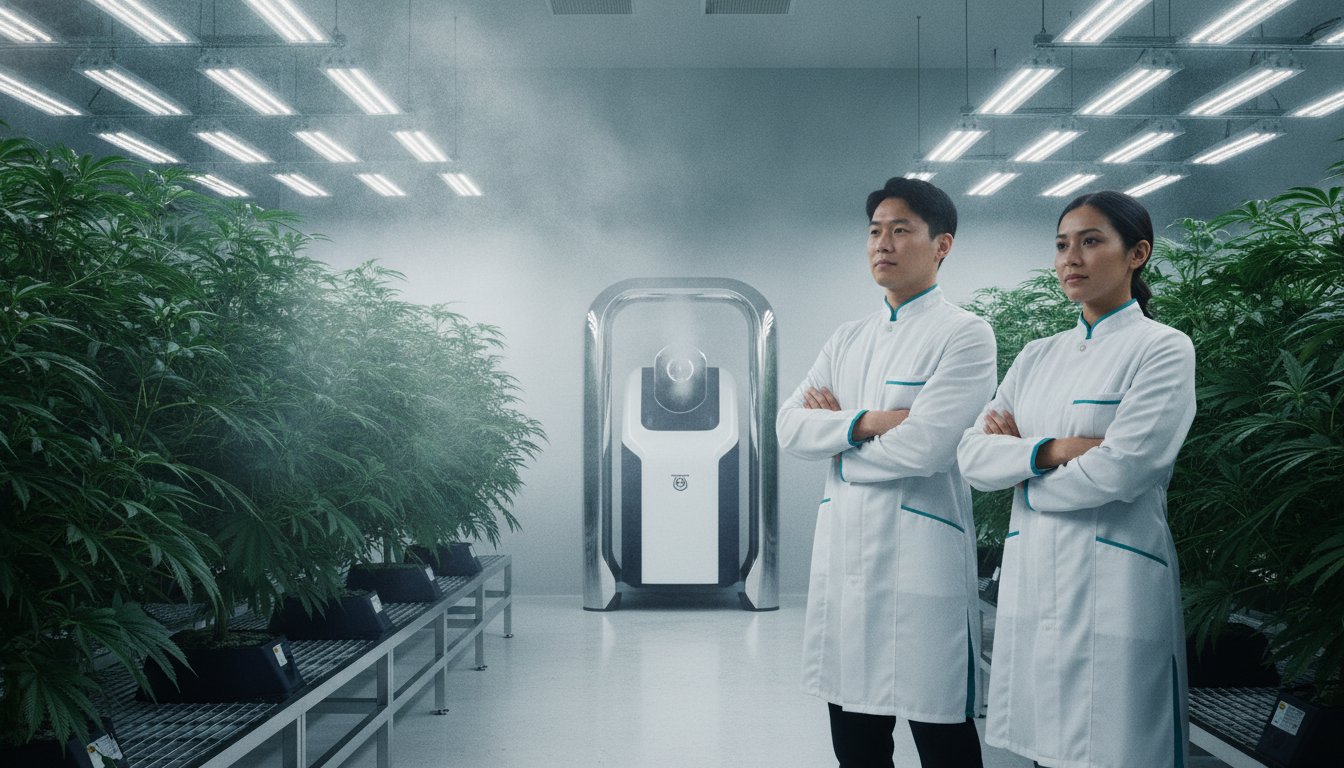
Traditional methods of addressing fungal outbreaks often involve aggressive demolition and high-moisture cleaning agents. For a commercial grower, this "rip and tear" approach is counterproductive, as it introduces dust and humidity into a controlled environment. Modern mold remediation for cannabis facilities utilizes Dry Fog technology, a sophisticated system that creates a sub-micron mist. These particles are so small that they behave like a gas, filling the entire volume of a room and penetrating areas that liquid sprays simply cannot reach.
Our methodical approach ensures that every square inch of your facility is addressed through a three-step protocol:
- Step 1: Comprehensive Inspection. We begin with lab-verified mold testing to identify specific pathogen types and concentrations. This data-driven start ensures the treatment is tailored to your facility's unique microbial profile.
- Step 2: Dry Fog Application. The sterilant is dispersed throughout the grow rooms, drying rooms, and hallways. It neutralizes airborne spores and surface-level colonies on contact without leaving surfaces wet.
- Step 3: Antimicrobial Shield. We apply a secondary fog that creates a microscopic, invisible barrier. This shield prevents new spores from attaching to surfaces, providing a long-term prevention strategy rather than a temporary fix.
This science-based method is a significant departure from standard mold remediation san francisco practices that rely on destructive techniques. It allows cultivators to maintain the structural integrity of their facility while achieving a clinical level of cleanliness.
How Dry Fog Protects Your Equipment
Grow rooms are filled with sensitive electronics, from high-end LED arrays to complex climate control sensors. Traditional wet fogging or heavy spraying can lead to electrical shorts, rust, or equipment failure. Because Dry Fog particles are smaller than 7.5 microns, they don't have enough mass to "wet" a surface. They bounce off electronics and sensitive components, ensuring that your investment remains safe. There's also zero residue left behind, which is vital for maintaining the purity and chemical profile of your cannabis plants. You don't have to worry about oily films or chemical smells lingering on your equipment or affecting your final product.
Total Room Sterilization
Spores don't just sit on flat benches; they congregate inside fan motors, electrical outlets, and light fixtures. These "unreachable" areas often serve as reservoirs for future outbreaks. The gas-like behavior of Dry Fog ensures that the sterilant enters every crevice, providing a level of total room sterilization that manual scrubbing can't match. One of the greatest benefits for commercial operations is the speed of the process. Most facilities can be fully treated and cleared for re-entry in a matter of hours. This minimizes downtime and keeps your production schedule on track, ensuring that your transition from remediation back to cultivation is as smooth as possible.

DCC Compliance and Lab Testing Requirements
California's regulatory framework for cannabis is exceptionally strict. The Total Yeast and Mold Count (TYMC) limit of 1,000 colony-forming units per gram (CFU/g) is ten times more rigorous than neighboring states like Oregon. Meeting these thresholds requires a proactive approach to mold remediation for cannabis facilities. Beyond TYMC, the DCC mandates specific screening for four species of Aspergillus: A. flavus, A. fumigatus, A. niger, and A. terreus. A single detection of these pathogens can trigger a mandatory product recall or batch destruction. Effective July 1, 2026, regulation DCC-2025-01-R established mandatory minimum sanitation standards for all licensees, making facility-wide cleanliness a legal necessity.
Interpreting lab results is a critical skill for facility managers. "Action Levels" define the point at which a contaminant renders a product unfit for sale. If your results show a trend toward the 1,000 CFU/g limit, it's a clear indicator that your facility's environmental controls are failing. Professional mold testing san francisco provides the baseline data needed to identify these trends before they result in a failed compliance audit. This data allows you to address localized issues before they become systemic across your entire crop.
Preparing for State Inspections
Compliance isn't a one-time event; it's a continuous state of operation. Under 2026 regulations, licensees must maintain all remediation and sanitation records for seven years. These documents must be readily available for DCC inspection at any time. A robust Standard Operating Procedure (SOP) should detail your "Clean Room" protocols post-remediation, ensuring that staff don't reintroduce pathogens into a sterilized environment. This includes strict gowning procedures and specialized airflow management. If you're facing a failed test or preparing for a state audit, partner with our compliance experts to secure your facility and protect your license.
Post-Remediation Verification
Once remediation is complete, verification is the final hurdle to clear. This involves conducting air and surface swabbing to confirm a 6-log reduction in microbial presence. It's important to remember that if a batch fails initial testing, California law requires that any post-remediation retesting be performed by a different, independent accredited lab than the one that issued the original failing result. This ensures an unbiased validation of the remediation's success. Maintaining a clear chain of custody for all environmental samples is essential for protecting your investment and proving your commitment to consumer safety in the San Francisco market.
Partnering with My Pure Environment SF for Cannabis Safety
San Francisco cultivators operate in one of the most demanding regulatory and environmental landscapes in the country. My Pure Environment SF acts as a protective guide for local businesses, offering specialized mold remediation for cannabis facilities that balances scientific precision with a deep understanding of harvest value. We recognize that your brand reputation rests on the purity of your product. A single failed test or a public recall can erase years of hard work. By choosing a science-based, non-invasive approach, you ensure that your facility remains a sterile environment without the risks associated with traditional, moisture-heavy cleaning methods.
Our team brings localized expertise to the table, specifically addressing the persistent humidity and fog that define the Bay Area. We don't just treat the symptoms of an outbreak; we partner with you to identify the systemic vulnerabilities in your building's health. This clinical approach reduces the stress of environmental hazards, providing you with the peace of mind that comes from knowing your facility is backed by a steady hand in a crisis. Our goal is to ensure your operation remains compliant, your employees stay safe, and your crops reach their full market potential.
Tailored Solutions for Commercial Greenhouses
Every cultivation site has a unique footprint. Whether you're managing an indoor warehouse in the Dogpatch or a mixed-light greenhouse on the outskirts of the city, our remediation plans are customized to your specific infrastructure. We provide scalable mold remediation for cannabis facilities that grows alongside your business. From boutique craft grows to large-scale commercial operations, we implement preventative maintenance programs designed to maintain Indoor Air Quality (IAQ) and protect your crops from the invisible threats that thrive in commercial environments. Our strategies are designed to be thorough yet efficient, ensuring that your production cycles continue with minimal interruption.
Get Started with a Professional Assessment
Securing your facility begins with a clear understanding of your current microbial load. During your initial consultation, we conduct a thorough evaluation of your grow rooms, drying areas, and HVAC systems. We look for the underlying causes of mold growth, such as micro-climates or irrigation leaks, and provide a structured path to resolution. This methodical progression ensures you feel informed and empowered at every stage of the narrative. We prioritize transparency and education, helping you understand the "why" behind every step of our process. Don't wait for a failed lab test to address your facility's health. Schedule your professional cannabis facility mold inspection today to ensure your next harvest meets the highest standards of safety and compliance.
Secure Your Harvest and Compliance for 2026
Maintaining a pathogen-free environment is the foundation of a successful cultivation business in California. Standard cleaning protocols often fail to address the microscopic spores that lead to devastating batch failures. By utilizing our specialized mold remediation for cannabis facilities, you can transition from reactive cleaning to a proactive, systemic prevention strategy. Our team leverages Dry Fog non-invasive technology to ensure every corner of your facility meets the strict DCC microbial standards without damaging your sensitive equipment or crops.
Our Specialized Cannabis and Mold Division brings San Francisco local expertise to every project, helping you navigate the unique humidity challenges of the Bay Area. We act as your compliance partner, ensuring your facility remains sterile and your brand reputation stays protected. Whether you're scaling a craft grow or managing a large commercial site, the right environmental controls make all the difference in your final yield.
Protect Your Yield and Schedule a Cannabis Facility Assessment today. You've worked hard to build your brand; let's ensure your facility supports your continued growth and success.
Frequently Asked Questions
Is mold remediation safe for live cannabis plants?
Yes, provided the method is non-invasive. Dry Fog technology uses sub-micron particles that behave like a gas, neutralizing pathogens without the high moisture levels that damage live tissue. This approach is specifically designed to protect plant health while sanitizing the growth environment. It's a safer alternative to traditional chemical sprays which can cause phytotoxicity or leave harmful residues on the leaves and flowers.
How long does the professional mold remediation process take for a grow room?
Most professional mold remediation for cannabis facilities can be completed in a single day. The Dry Fog application itself typically takes a few hours depending on the square footage and complexity of the facility. Because the process is non-destructive and doesn't require rip and tear demolition, your team can often re-enter the space shortly after the treatment is finished. This minimizes operational downtime and keeps your production cycles on schedule.
Will the chemicals used in remediation affect the taste or smell of my flower?
No, the sterilants used in our Dry Fog process are designed to leave zero residue. Because the particles are smaller than 7.5 microns, they don't wet the surfaces or soak into the flower's resin glands. This protects the delicate terpenes and cannabinoids that define your product's flavor profile and potency. Our science-based approach ensures that the purity of your final cannabis product remains entirely intact while pathogens are eliminated.
Do I need to fail a lab test before calling a remediation specialist?
You shouldn't wait for a failed lab test to seek professional help. Proactive environmental testing allows you to identify rising microbial levels before they reach the DCC's 1,000 CFU/g limit. Early intervention through specialized mold and cannabis services can save an entire harvest from mandatory destruction. Regular assessments act as an insurance policy for your crop value, ensuring your facility stays ahead of potential contamination issues and regulatory scrutiny.
Can dry fogging reach mold inside my HVAC and ventilation systems?
Yes, one of the primary benefits of Dry Fog technology is its ability to penetrate HVAC ducting and ventilation systems. Since the fog behaves like a gas, it follows the natural airflow of your facility, reaching hidden reservoirs where spores often congregate. This systemic treatment is essential for preventing cross-contamination between rooms. It ensures that your air handling units aren't recirculating pathogens every time the climate control system activates.
What is the difference between mold removal and professional remediation for cannabis?
Mold removal often refers to the simple physical act of cleaning visible growth, which usually ignores airborne spores. Professional mold remediation for cannabis facilities is a systemic process that addresses the root cause of the outbreak. It involves lab-verified testing, air sterilization, and the application of an antimicrobial shield. This comprehensive strategy ensures that pathogens are not just moved around but are actually eliminated from both surfaces and the air.
How often should a commercial cannabis facility be tested for mold?
We recommend a monthly environmental testing schedule for commercial facilities to maintain DCC compliance. Frequent swabbing of surfaces and air sampling help you monitor the effectiveness of your sanitation SOPs. In the high-humidity environment of San Francisco, consistent monitoring is the only way to detect Aspergillus or powdery mildew before they become systemic. Regular data points allow you to adjust your climate controls and prevent costly harvest losses.
Does My Pure Environment SF provide compliance documentation for the DCC?
Yes, we provide detailed documentation and post-remediation verification reports that are essential for regulatory audits. Under 2026 DCC regulations, licensees must maintain sanitation and remediation records for seven years. Our reports include lab-verified results and a summary of the remediation steps taken, providing clear proof of your commitment to consumer safety. This documentation serves as a critical asset during state inspections and final product audits in San Francisco.