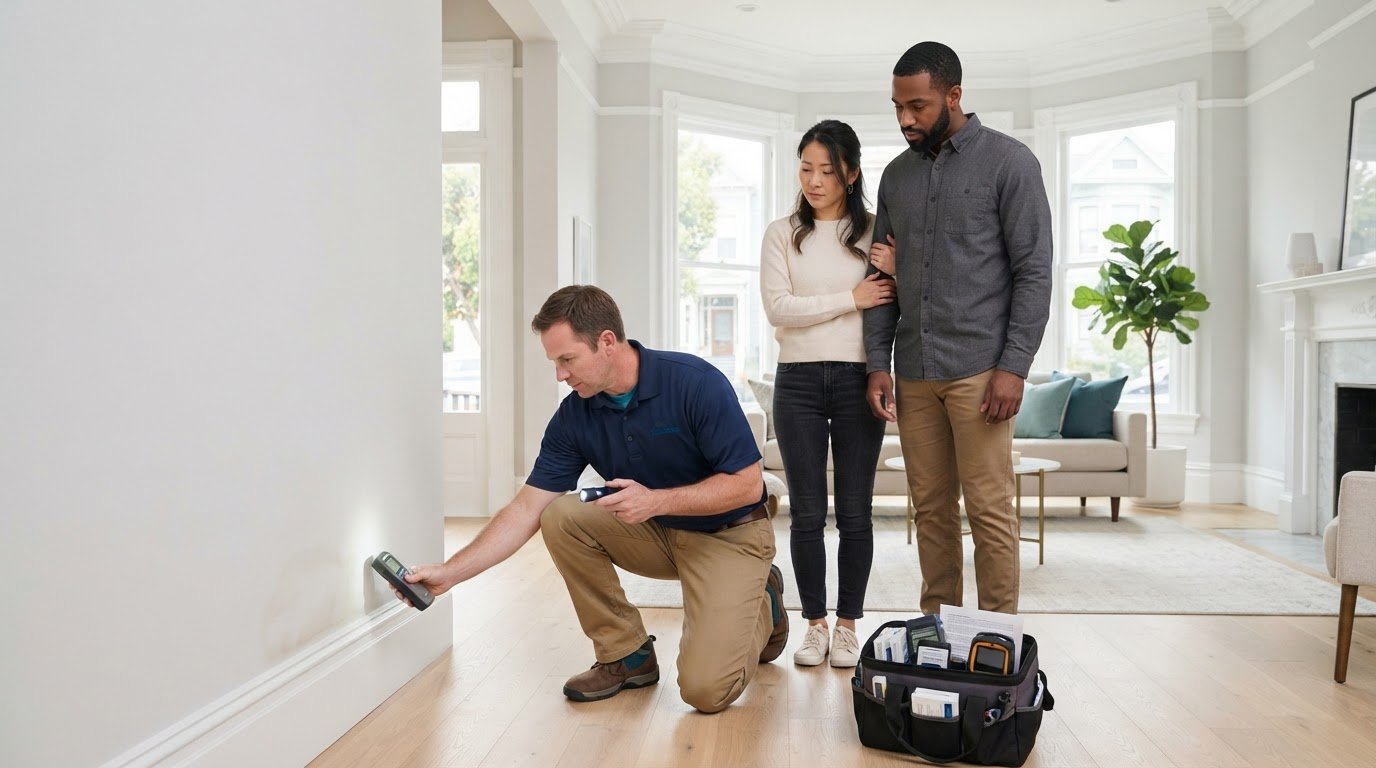

What if the most effective way to protect your home from mold didn't involve a sledgehammer or a week in a hotel? For many property owners in the San Francisco Bay Area, the discovery of a public health nuisance like visible mold often triggers an immediate sense of dread. You're likely bracing for the high costs of reconstruction and the anxiety of displacing your family while your walls are torn down. It's natural to feel skeptical that mold removal without demolition is a viable option when the problem seems so deeply embedded in your home's structure.
We understand that your primary goal is a safe, healthy environment without the collateral damage of a traditional construction project. This guide explores the science of non-invasive remediation, showing you how advanced dry fog technology eliminates spores at their source. You'll discover how to achieve a mold-free home confirmed by professional lab tests without moving out or destroying your property. We will walk through the entire process, from initial detection to the final verification of your indoor air quality, ensuring you have the technical clarity needed to make an informed decision for your family's well-being.
Key Takeaways
- Understand how specialized antimicrobial mists neutralize mold spores in the air and on surfaces simultaneously, addressing the entire building system.
- Learn about the "micron factor" that allows dry fog to behave like a gas, penetrating wall cavities and porous materials without structural removal.
- Discover why mold removal without demolition typically costs 40 to 60 percent less than traditional methods and can be completed in just a few hours.
- Find out how non-invasive remediation protects the delicate plaster and original wood of San Francisco's historic Victorian homes from unnecessary damage.
- Learn why professional third-party lab verification is essential for confirming that your indoor air quality has returned to safe, healthy levels.
What is Mold Removal Without Demolition?
Mold removal without demolition is a specialized remediation strategy that utilizes advanced antimicrobial mists to neutralize fungal growth at a microscopic level. Unlike traditional methods that rely on the physical removal of building materials, this approach targets mold colonies on surfaces and airborne spores simultaneously. It treats the entire property as a singular ecosystem rather than a collection of isolated surfaces. This systemic focus is essential because Indoor mold issues are rarely limited to a single visible patch on a wall; they often represent a broader air quality concern that requires a comprehensive solution.
For most non-structural mold issues, the standard "tear-out" approach is often an unnecessary escalation that adds stress to an already difficult situation. When mold hasn't compromised the physical integrity of a wall or ceiling, demolition creates more problems than it solves. We believe in a surgical approach that preserves your home's structure. Professional testing plays a critical role in this process, providing the empirical data needed to validate that the environment is safe without the need for costly reconstruction. By focusing on the science of sterilization, we can ensure a healthy home without the mess of a construction site.
The Limitations of Traditional Remediation
Traditional remediation often involves aggressive cutting and removal of drywall and insulation. This physical disruption can inadvertently aerosolize millions of spores, allowing them to migrate to previously unaffected areas of the home through the air. Beyond the risk of cross-contamination, the hidden costs of reconstruction can be staggering for a property owner. You often find that the price of replacing walls, paint, and trim far exceeds the cost of the initial mold treatment. Additionally, these manual methods frequently overlook the HVAC system, leaving a reservoir of spores that can recirculate through the property indefinitely.
The Rise of Non-Invasive Technologies
The transition toward non-invasive technologies began in high-stakes environments like hospital surgical suites and food processing plants where cleanliness is a regulatory requirement. Today, these sterilization techniques are adapted for residential use, shifting the focus toward Indoor Air Quality (IAQ) as the primary metric of success. San Francisco homeowners are increasingly opting for mold removal without demolition to protect their investments and their health. In a city known for its historic architecture and complex microclimates, maintaining structural integrity while ensuring a healthy living space is a top priority for meticulous property owners who value efficiency and scientific accuracy.
The Science of Dry Fog: How It Reaches Behind Your Walls
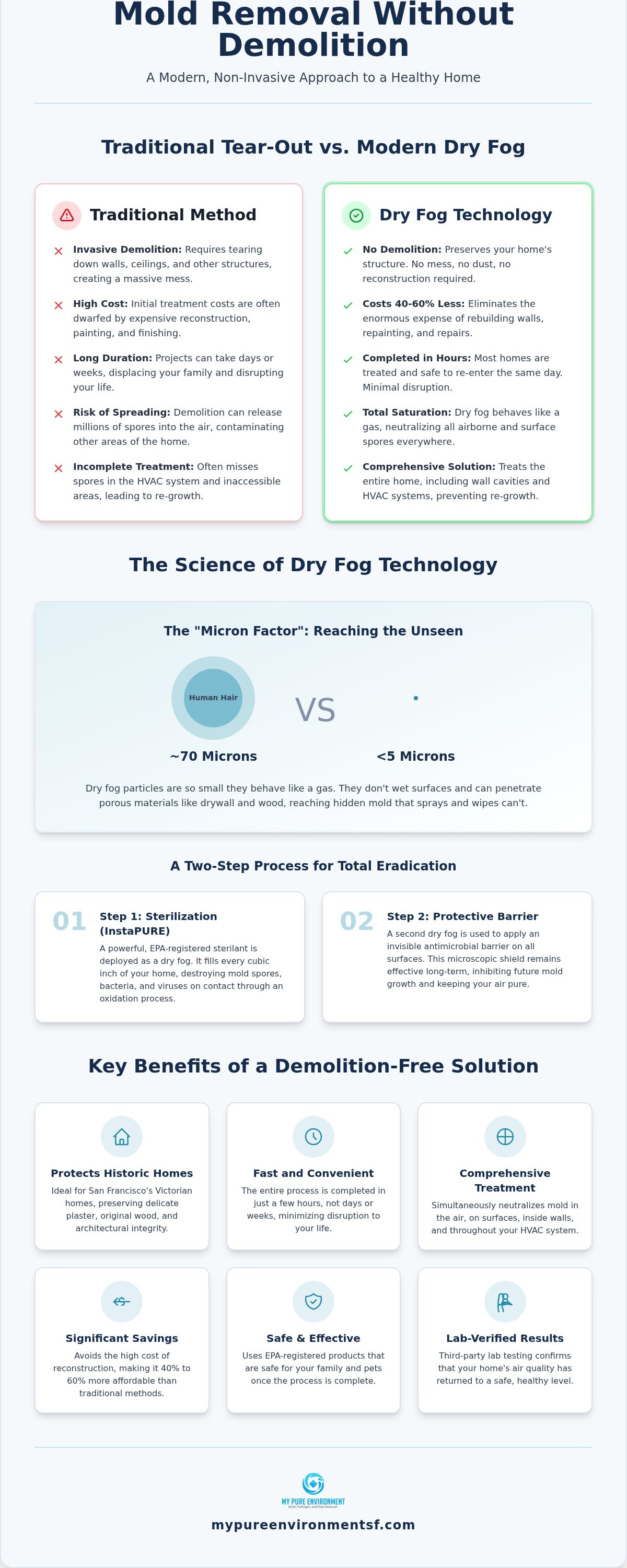
Dry fog technology is a significant advancement in the field of environmental restoration, operating on the principles of physics rather than simple mechanical cleaning. Standard fogging equipment often creates a wet mist with large droplets that settle quickly and only coat visible surfaces. In contrast, the technology used for mold removal without demolition produces particles smaller than 5 microns. To visualize this scale, consider that a typical human hair is approximately 70 microns in diameter. Because these particles are so small, they lack the surface tension required to burst or "wet" a surface upon contact. Instead, they behave like a gas, filling the entire cubic volume of a room and reaching areas that are physically inaccessible to human hands.
This gas-like behavior allows the treatment to penetrate deep into the "roots" of mold colonies embedded in porous materials. While the EPA guide to mold cleanup provides essential foundations for managing moisture and cleaning accessible areas, dry fog addresses the hidden reservoirs of spores. It moves through the same microscopic pathways that air does, seeping into wall cavities, under floorboards, and deep into the fibers of insulation. This systemic approach ensures that every cubic inch of your living space is addressed, providing a level of thoroughness that traditional "cut and pull" methods often fail to achieve.
Step 1: The Sterilant (InstaPure)
The first phase of the remediation process utilizes a powerful sterilant that destroys fungal growth at the cellular level. As the fog fills the room, it initiates an oxidation process that targets the cell walls of mold spores, neutralizing them instantly. Because the particles are dry, they don't introduce new moisture into the environment, which is a common failure point in other liquid-based treatments. This step is characterized by a "bounce" effect; the particles reflect off surfaces until they find every hidden corner, including the back of cabinets and the interior of HVAC ductwork. The safety profile of this sterilant is a primary benefit, as it breaks down into simple components that leave no toxic residue behind for families or pets.
Step 2: The Protective Barrier (EverPure)
Following the sterilization phase, a second application creates an invisible, antimicrobial shield across all treated surfaces. This layer is composed of millions of microscopic "spikes" that mechanically puncture and destroy any new mold spores that attempt to land. Unlike traditional cleaners that evaporate and lose efficacy, this barrier provides a long-term defense against re-colonization. This antimicrobial shield remains electrostatically bonded to your home's surfaces for months, providing ongoing protection without the need for constant reapplication. If you suspect your property has hidden issues, a professional mold testing and inspection can determine if this two-step systemic approach is the right solution for your home.
Traditional Tear-Out vs. Non-Invasive Remediation
Choosing between traditional methods and modern technology often comes down to a balance of cost and time. Traditional tear-out remediation is labor-intensive, often requiring a multi-person crew and extensive structural work. When you factor in the cost of new drywall, paint, and finishing labor, the total invoice can be overwhelming. Non-invasive mold removal without demolition typically costs 40 to 60 percent less than these reconstruction-heavy projects. The timeline is equally stark. While a standard tear-out might displace your family for 7 to 14 days, a dry fog treatment is usually completed within 2 to 5 hours.
Beyond the financial aspect, the physical disruption of a "tear-out" can be distressing. Traditional contractors often create plastic containment bubbles that restrict access to your home and can still leak dust-filled air into living areas. Because dry fog treats the air as a whole system, it addresses the "out of sight" spores that traditional cleaning might miss. This is critical because the health effects of mold are often linked to these microscopic airborne particles rather than just the visible growth on a surface.
When Demolition is Still Necessary
While we advocate for non-invasive solutions, there are specific instances where demolition is unavoidable. If mold has led to structural rot where the wood is crumbling or unable to support weight, those materials must be replaced. We also advise caution with the "10 square foot" rule; if visible mold covers more than a small area, DIY attempts become dangerous. In these cases, we prioritize mold remediation vs mold removal as a holistic approach. Remediation focuses on returning the environment to a safe state, whereas simple removal might ignore the systemic air quality issues caused by hidden colonies.
Material Salvage Checklist
One of the greatest benefits of dry fog is its ability to salvage materials that were previously considered lost. This technology allows us to treat the property without the waste associated with traditional demolition. Key items we can often save include:
- Drywall: Usually salvageable with dry fog if the structural integrity remains intact and there is no significant water-driven crumbling.
- Upholstery and Carpets: Fogging is superior to steam cleaning because it neutralizes spores deep within the fibers without adding moisture that could trigger new growth.
- HVAC Systems: This is the only effective way to clean ducts without disassembly, ensuring your home's ventilation path is free from contaminants.
By using a process that requires zero structural damage, you can maintain the integrity of your home while ensuring the air you breathe is pure. If you are dealing with a complex situation, a professional mold testing and inspection can help determine which materials are candidates for salvage.
Is Non-Invasive Mold Removal Right for Your SF Home?
San Francisco property owners face unique environmental hurdles that demand specialized solutions. The city's signature fog isn't just an aesthetic feature; it's a constant source of moisture that can lead to systemic mold issues. In high-humidity neighborhoods like the Sunset or Richmond, mold removal without demolition becomes a necessity rather than a luxury. Traditional methods often fail to address the underlying air quality issues that persist after visible mold is scrubbed away. For those living in historic Victorians, the thought of a contractor taking a saw to original wood or lath-and-plaster walls is painful. Non-invasive methods preserve the architectural heritage of these homes while ensuring they remain healthy living spaces.
In the context of San Francisco's rental market, the "Apartment Challenge" is a significant concern for both landlords and tenants. California law generally requires landlords to address mold issues within 30 days of receiving written notice. Under SB 567, tenants have specific protections during substantial remodeling. Using dry fog technology allows for thorough remediation without the logistical nightmare and high costs of displacing tenants for weeks. This technology also serves the local commercial sector, providing a safe, effective solution for the cannabis industry and professional offices where structural demolition would result in unacceptable downtime.
Attic and Crawl Space Solutions
Attics are often the primary candidates for no-demo remediation in the Bay Area. These spaces frequently suffer from poor ventilation and fog-driven moisture accumulation. Tight eaves and low-clearance crawl spaces make traditional cleaning nearly impossible for human crews. Because dry fog behaves like a gas, it reaches these inaccessible areas and penetrates deep into the insulation where spores hide. This approach is the cornerstone of effective attic mold remediation san francisco, providing a level of coverage that manual scrubbing simply cannot match.
Bathroom Mold and Ventilation Issues
Bathrooms in older San Francisco homes often struggle with persistent "moldy ceiling" problems. While homeowners often try to solve this with surface cleaning or bleach, these efforts fail to address the spores living inside the ventilation fan and wall cavities. In high-humidity areas, mold can quickly return if the entire system isn't sterilized. Our non-invasive process treats the air and the surfaces simultaneously, neutralizing the reservoir of spores that trigger regrowth. If you're a landlord or homeowner facing these persistent moisture challenges, scheduling a professional mold testing and inspection is the first step toward a non-disruptive resolution.
Choosing Professional Mold Remediation in San Francisco
Choosing a provider for mold removal without demolition requires a partner who prioritizes scientific accuracy over construction revenue. At My Pure Environment SF, we maintain a strict focus on environmental health. We don't offer general construction or rebuilding services. This specialization is a deliberate choice; it ensures that our recommendations are based solely on the data gathered during your inspection rather than a desire to generate additional profit through a rebuild. By removing the incentive for demolition, we provide you with a transparent, honest assessment of your property's needs.
Transparency is the cornerstone of our service. We believe you deserve empirical proof that your home is safe. That's why we insist on third-party lab verification after every remediation project. This independent testing confirms that the fungal ecology of your home has returned to a healthy state. We adhere to a structured mold remediation process steps that ensures every stage, from initial containment to final air clearance, is handled with meticulous care. This methodical approach provides peace of mind, knowing that your indoor air quality is being managed by specialists.
Our Science-First Approach
Every successful project begins with precision mold testing san francisco. We use advanced air and surface sampling to map the exact concentration of spores throughout your property. This data-driven foundation allows us to target our dry fog treatment with surgical accuracy. Because we aren't a general contractor looking for a tear-out project, we can focus entirely on the biology of the problem. Our mission is to restore the systemic health of your environment without the unnecessary destruction of your property's physical structure.
Next Steps for a Mold-Free Home
Preparing for a non-invasive treatment is a straightforward process that requires minimal effort from the homeowner. Unlike traditional methods that require packing up entire rooms, you'll only need to ensure internal doors are open and that pets and residents are out of the property during the application. The entire remediation window typically lasts about four hours. During this time, our dry fog technology works to neutralize spores in every corner of your home, including the HVAC system and wall cavities. Once the process is complete, you can return to a fresh, healthy environment immediately. If you're ready to address your air quality concerns with a fast, non-disruptive solution, you can Schedule your professional mold inspection with My Pure Environment SF today.
Restoring Your Home's Health Without the Mess
Modern technology has fundamentally changed the landscape of environmental restoration. By utilizing sub-5 micron particles, dry fog treats your property as a complete system rather than just a collection of isolated surfaces. This advanced method ensures that hidden spores in attics, bathrooms, and HVAC systems are neutralized without the need for a sledgehammer. Choosing mold removal without demolition allows you to protect your investment while avoiding the high costs and significant stress associated with traditional reconstruction.
My Pure Environment SF brings specialized local expertise to every project, focusing on science-based solutions that prioritize your indoor air quality. We include 3rd-party laboratory verification with our services to provide empirical proof that your home's ecology has returned to a safe state. Because we don't perform general construction, our only focus is the purity and safety of your living space. You don't have to choose between a healthy home and your property's structural integrity. Take the first step toward peace of mind and Request Your Non-Invasive Mold Inspection in San Francisco today.
Frequently Asked Questions
Is mold removal without demolition as effective as tearing out walls?
Yes, dry fogging is often more effective than traditional methods because it addresses the building as a whole system. While tearing out walls removes visible growth, it often leaves microscopic spores behind in the air or within structural cavities. Non-invasive mold removal without demolition ensures that these hidden reservoirs are neutralized, providing a more comprehensive solution that reaches areas a saw simply cannot access.
How long does the dry fog mold remediation process take?
The entire dry fogging process is typically completed within a four-hour window. This is significantly faster than traditional construction-based methods, which can take several days or even weeks to finish. Because there is no need for demolition or reconstruction, you can return to your home the same day the treatment is performed. This speed makes it an ideal choice for busy San Francisco families and local businesses.
Is the dry fog chemical safe for children and pets?
Yes, the sterilizing agents used in our dry fog process are safe for children, pets, and the environment. The primary agent breaks down into simple, non-toxic components like oxygen and water, leaving no harmful residues on your furniture or surfaces. This clinical approach allows us to restore your home's purity without introducing the harsh chemical odors or toxic VOCs often associated with industrial cleaning products.
Do I need to move out of my house during a no-demo mold treatment?
No, you don't need to move out of your home for several days. You only need to vacate the property during the four-hour treatment window. Once the fog has settled and the air has cleared, it's perfectly safe to return and resume your normal activities. This lack of disruption is a major benefit for tenants and property owners who want to avoid the high costs of temporary housing or hotel stays.
Can dry fogging reach mold inside the HVAC and ductwork?
Yes, dry fogging is specifically designed to reach into HVAC systems and ductwork without disassembly. Because the particles are smaller than 5 microns, they move through your home's ventilation paths just like air. This ensures that any mold spores hiding in your furnace, coils, or ducts are neutralized, preventing the system from recirculating contaminants throughout your living space after the treatment is complete.
What happens if the mold is caused by a structural water leak?
If mold is the result of an active structural leak, the water source must be repaired before the remediation process begins. Dry fogging is highly effective at neutralizing existing mold and providing a protective barrier, but it doesn't fix plumbing or roof issues. We recommend working with a specialist to stop the moisture intrusion first to ensure that your mold removal without demolition remains a permanent solution for your home.
Does insurance cover non-invasive mold removal?
Many insurance carriers do cover non-invasive remediation, as it is often more cost-effective than traditional tear-out methods. Most policies include a provision for mold remediation, and they generally prioritize the most efficient path to restoring the property to a safe state. We suggest reviewing your specific policy or speaking with your adjuster to confirm that non-invasive technology is recognized under your coverage limits.
How do I know the mold is actually gone if the walls weren't removed?
We confirm the success of our treatments through independent, third-party laboratory verification. After the remediation is complete, air and surface samples are collected and sent to a lab to measure spore counts. This objective data provides empirical proof that your home's air quality has returned to safe levels. It's the most reliable way to ensure the environment is healthy without needing to physically see behind the walls.