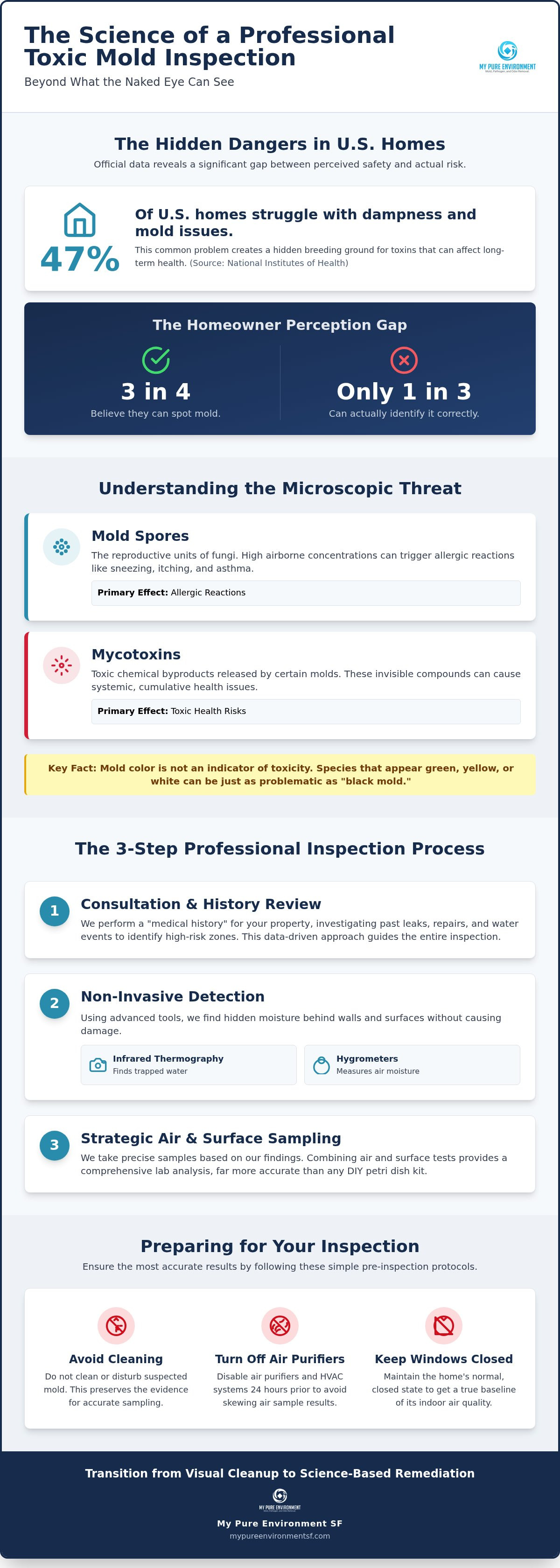
According to the National Institutes of Health, 47% of homes in the United States struggle with dampness and mold issues. Despite this prevalence, a survey by Talker Research found that while three out of four homeowners believe they can spot an infestation, only one in three can actually identify mold correctly. This gap between perception and reality is why a professional toxic mold inspection is more than just a visual check; it is a scientific investigation into your home's complex ecosystem. It's natural to feel concerned about the long-term health effects of mycotoxins, especially when the advice from national agencies seems to contradict what you see in your own living space.
We understand that the worry of hidden growth can feel like a heavy burden on your peace of mind. This guide provides the scientific reality behind indoor air quality and explains how a specialized inspection identifies hidden health risks that the naked eye often misses. You'll gain a clear roadmap for the detection process, including the use of advanced sensors and thermal imaging. By the end of this article, you will have the knowledge needed to navigate a professional assessment and ensure your environment is truly safe and pure.
Key Takeaways
- Understand the biological difference between mold spores and the mycotoxins they produce, which are the actual compounds posing systemic health risks.
- Discover how a professional toxic mold inspection utilizes advanced moisture meters and thermal imaging to detect hidden moisture sources without damaging your property.
- Learn why combining air and surface sampling provides a more accurate assessment of indoor air quality than DIY petri dish kits.
- Follow specific pre-inspection protocols, such as avoiding cleaning or air purifiers, to ensure your test results reflect the home's true environmental state.
- Transition from visual cleanup to science-based remediation that neutralizes microscopic toxins and restores your home to a state of purity.
Understanding Toxigenic Mold: Mycotoxins vs. Spores
The phrase "toxic mold" is frequently used in headlines and casual conversation, but it's technically a biological misnomer. Mold itself isn't toxic; rather, certain species are toxigenic, meaning they have the biological capacity to produce secondary metabolites known as mycotoxins. These chemical compounds are the primary drivers of health concerns in a domestic environment. While mold spores are reproductive units that can cause allergic reactions, mycotoxins are defense mechanisms that fungi release to compete with other microorganisms. A professional toxic mold inspection clarifies these distinctions by testing for the presence of these specific metabolites rather than just looking for discoloration.
Homeowners often request a toxic mold inspection when they see dark spots, but the science goes much deeper than a simple visual check. You cannot determine a mold's toxicity by its color alone. While Stachybotrys chartarum, commonly known as black mold, is the most infamous toxigenic species, other common fungi like Aspergillus and Penicillium can be just as problematic. These species can appear in shades of green, yellow, or white, yet they still produce potent mycotoxins that compromise indoor air quality. Relying on visual identification is a significant risk because it ignores the microscopic chemical reality of the environment.
The Science of Mycotoxin Exposure
Mycotoxins don't travel alone. These microscopic compounds often attach themselves to dust particles and airborne spores, allowing them to circulate through your home's ventilation system. When inhaled, they can bypass the body's initial respiratory defenses. Mycotoxins are chemical byproducts of certain fungi that require specific laboratory detection. Unlike simple allergens that cause immediate sneezing or itching, mycotoxin exposure often has a cumulative effect. Over time, the buildup of these toxins in a confined space can lead to systemic health issues, making precise detection essential for long term safety.
Why San Francisco Homes are Susceptible
San Francisco's unique climate creates a persistent challenge for maintaining a pure indoor environment. The famous "Marine Layer" brings consistent fog and high humidity levels that can seep into building envelopes. In many of the city's historic Victorian homes, lath-and-plaster walls are common. While beautiful, these materials are notorious for trapping moisture within wall cavities. When moisture is caught behind these dense layers, it creates a perfect incubator for toxigenic species to thrive unseen. If you suspect your property is harboring hidden growth, you can learn more about the specifics in our Toxic Mold Identification: A Homeowner’s Guide. Understanding these local structural vulnerabilities is the first step toward effective detection and restoration.
The Professional Toxic Mold Inspection Process
A professional toxic mold inspection begins with a detailed consultation that functions like a medical history for your property. We don't simply walk into a room and start taking samples. Instead, we review the building's history, looking for past plumbing failures, roof leaks, or structural repairs that might have left behind residual moisture. This investigative phase is vital because mold often thrives in the wake of forgotten water events. By understanding the timeline of your home, we can pinpoint high-risk zones that require deeper scrutiny.
The transition from consultation to physical assessment involves a systematic walk-through. While some generic advice suggests that visual inspection is enough, we know that what you see is often just the surface of a larger systemic issue. Our specialists use a combination of experience and technology to map out the moisture profile of your living space. This data-driven approach ensures that every sample we eventually collect is backed by a specific hypothesis about where and why mold is growing.
Non-Invasive Detection Tools
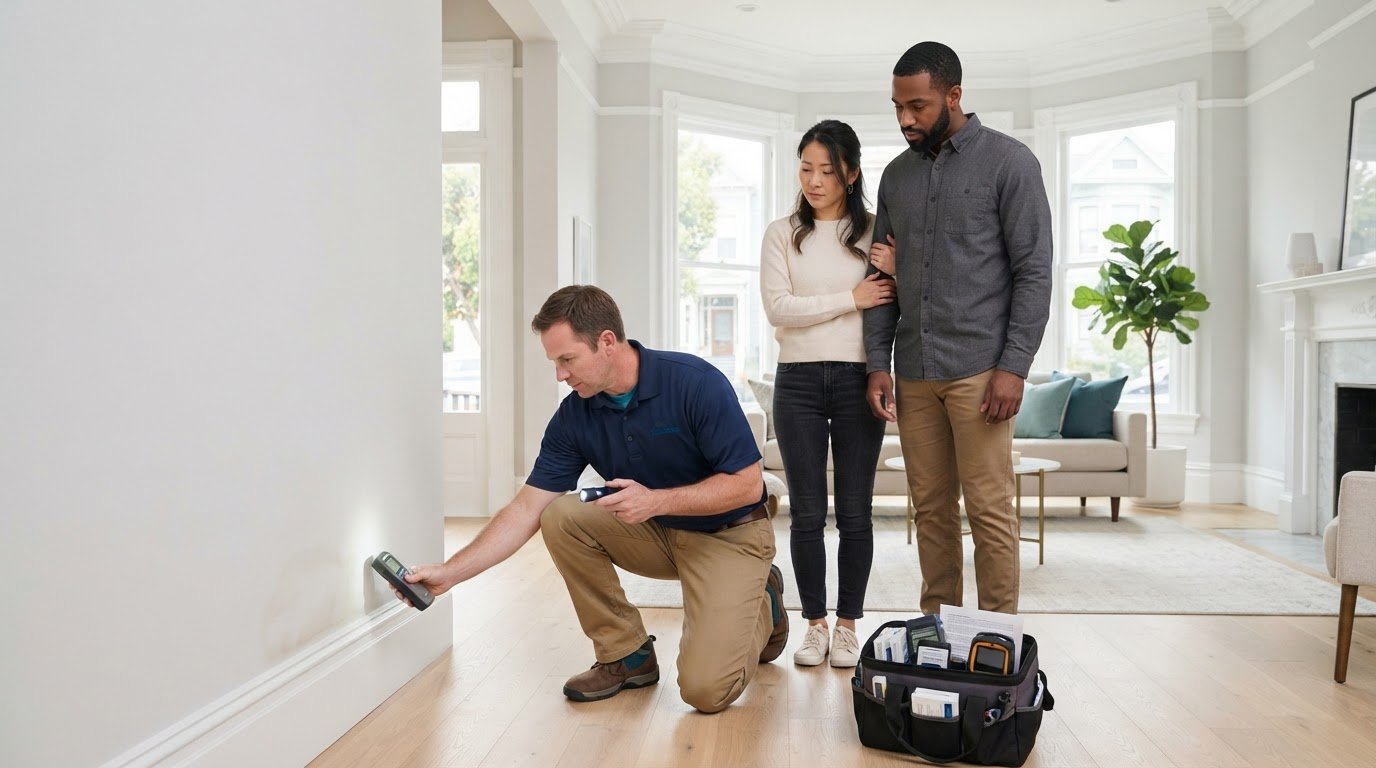
Modern technology allows us to see what lies beneath the surface without damaging your home's finishes. Infrared thermography is essential for identifying moisture signatures hidden behind San Francisco's standard drywall or historic lath-and-plaster. These thermal cameras detect temperature variations that often indicate trapped water. We also utilize hygrometers to measure relative humidity levels; consistent moisture in the air often triggers spore release and facilitates growth. Our specialists prioritize often-overlooked areas like attics and crawl spaces, where stagnant air and temperature fluctuations frequently lead to hidden colonies.
Identifying Moisture Sources in the Bay Area
San Francisco's diverse microclimates significantly influence indoor mold risk. Residents in the fog-heavy Sunset District face constant exterior humidity that can compromise window seals and exterior siding over time. In contrast, homes in the warmer Mission District might struggle more with poor bathroom ventilation or basement seepage in older building stock. Common culprits across the city include leaking window seals and inadequate ventilation in high-moisture areas. If you're unsure which standards apply to your specific neighborhood, you can review our guide on Choosing Mold Inspection Professionals.
Once moisture sources are identified, we move to strategic sampling. We determine the most effective locations for air or surface collection based on our visual and technical findings. These samples are then sent to accredited mycological labs for rigorous analysis. The final stage is the delivery of a comprehensive report that translates raw lab data into a health-focused action plan. This document provides the clarity you need to restore your indoor air quality. If you're concerned about the air in your home, scheduling a professional mold testing and inspection can provide the scientific answers you need.
Air vs. Surface Testing: Which Method Finds the Toxins?
A comprehensive toxic mold inspection requires a multi-faceted sampling strategy. We don't rely on a single data point because different fungi behave differently within a structure. Air sampling measures the concentration of airborne spores per cubic meter, providing a clinical look at the air you're breathing. Surface sampling, such as tape lifts or swabs, identifies the exact species on a specific area to confirm if a stain is active growth. When we suspect deep contamination, we use bulk sampling to analyze physical pieces of insulation or drywall. For a more sophisticated look at the property's history, we use the Environmental Relatives Moldiness Index (ERMI). This DNA-based approach maps the fungal DNA in settled dust, offering a long-term view of the home's environmental health that short-term air tests might miss.
When Air Testing is Essential
Professional air testing becomes essential in scenarios where occupants suffer from respiratory issues or unexplained fatigue, yet no visible growth appears. It's the most effective tool for locating hidden colonies that have compromised the indoor air quality from behind walls or inside cabinetry. Beyond initial detection, air sampling is mandatory for post-remediation clearance. It provides the scientific proof that a cleanup was successful and the air has returned to a baseline level of purity. For a deeper dive into the methodology, explore our article on Mold Spore Air Testing: Accuracy and Benefits.
The Limitations of DIY Mold Kits
While DIY mold kits from big-box retailers are popular, they rarely provide actionable data for a homeowner's safety. These "petri dish" tests are highly susceptible to false positives because they don't account for the fact that mold spores are naturally present in almost all outdoor air. A kit that grows mold isn't necessarily proof of a toxic problem in your home. These kits also fail to provide regional context; they won't tell you if the spores they captured are typical for San Francisco's damp, coastal environment or if they represent a dangerous indoor bloom. Without professional laboratory interpretation and a controlled comparison to outdoor air samples, these kits often cause unnecessary anxiety. A professional toxic mold inspection provides the necessary lab-verified evidence and expert interpretation that DIY kits lack.
Preparing for Your Inspection and Interpreting Results
The accuracy of a toxic mold inspection depends heavily on the state of the environment at the moment of testing. To get a representative snapshot of your home's air quality, you must avoid temporary fixes that mask underlying issues. If you alter the indoor conditions immediately before a specialist arrives, you risk creating a false sense of security while leaving systemic health hazards undetected. Our goal is to capture the most authentic data possible to ensure your family's safety.
Homeowner Preparation Steps
To ensure the validity of air samples, we require "closed building conditions" for at least 24 hours prior to our arrival. This means keeping all windows and exterior doors shut, as open windows allow outdoor spores to flood the interior and dilute the data. You should also refrain from running high-efficiency particulate air (HEPA) purifiers or performing deep cleaning in the suspected areas. Scrubbing away visible growth or filtering the air removes the very evidence we need to measure. We also suggest that you document any musty odors that fluctuate with the weather; these scents are often the first sign of active microbial growth behind walls. Identifying "hot spots," such as bathrooms with poor ventilation or rooms that have suffered previous plumbing failures, helps our team prioritize the most vulnerable zones in your property.
Reading the Mycological Lab Report
When you receive your lab results, the raw numbers can feel overwhelming. The most important metric is the comparison between indoor spore levels and the outdoor baseline samples. In a healthy environment, indoor concentrations should be significantly lower than the air outside. If specific species are higher indoors, it indicates an active internal source. We also look for "marker species." While some fungi are common, finding even a single spore of Stachybotrys or Chaetomium is a red flag that requires immediate attention. These toxigenic species are not typically found in clean indoor air and signal a need for professional intervention.
It's also vital to distinguish between viable and non-viable spores. Viable spores are living and capable of reproduction, while non-viable spores are "dead." However, from a health perspective, both are significant. Even dead spores can carry mycotoxins and trigger respiratory distress or allergic reactions. Understanding these nuances is a key part of our San Francisco Mold Testing Guide for Property Owners. If your report indicates elevated levels of toxigenic fungi, the next step is a structured plan for restoration. You can schedule a professional mold inspection today to get a clear, science-based analysis of your home's health.
The Path to Purity: Science-Based Remediation
Once a professional toxic mold inspection identifies the specific species and concentrations in your home, the focus shifts from detection to systemic restoration. It's a common misconception that simply scrubbing away dark spots with household cleaners resolves the issue. Because mycotoxins are chemical metabolites rather than just physical organisms, they require a specialized approach to neutralize. Visual removal is only the first step; true safety depends on addressing the microscopic particles that have permeated your home's air and hidden surfaces.
Our approach at My Pure Environment SF prioritizes your health by focusing on indoor air quality without the conflict of interest of general construction. We act as clinical specialists rather than general contractors. This means we don't look for excuses to tear down walls or engage in invasive demolition unless it's absolutely necessary for structural integrity. By using advanced technology to treat the air and surfaces simultaneously, we restore your environment to a state of purity while minimizing the stress and mess of traditional remediation methods.
Beyond Scrubbing: Systemic Solutions
Many property owners reach for bleach when they see mold, but this often does more harm than good on porous materials like drywall. Bleach is primarily composed of water; while the chlorine stays on the surface, the water soaks into the material and actually feeds the fungal roots. This leads to a cycle of regrowth that only a professional can break. We utilize specialized technology that generates a dry fog, allowing antimicrobial agents to reach spores hidden deep within wall cavities and ventilation systems. This clinical approach ensures that the remediation is comprehensive, neutralizing mycotoxins that traditional scrubbing leaves behind.
Protecting Your SF Property Long-Term
Maintaining a mold-free home in San Francisco requires a proactive strategy against the city's persistent humidity. High-quality dehumidifiers are essential in damp basements or street-level units where the marine layer often drives moisture levels above the 50% threshold that triggers mold growth. Regular HVAC maintenance is also vital to prevent your ventilation system from becoming a distribution network for spores. Ensuring that bathroom fans are vented to the exterior and that window seals remain intact will help manage the microclimates within your home. For a detailed look at our restoration methodology, you can read more about Professional Mold Remediation in San Francisco. By combining science-based detection with systemic prevention, you can maintain a healthy, pure environment for years to come.
Restoring Your Home’s Environmental Health
Protecting your family from the systemic risks of mycotoxins requires more than just a visual check. The scientific reality of indoor air quality involves understanding how microscopic toxins travel and settle within your living space. By choosing a professional toxic mold inspection, you move beyond guesswork and gain access to detailed lab reporting that identifies specific biological threats. This data-driven approach is the only way to ensure that your restoration plan addresses the root cause of the issue rather than just the visible symptoms.
My Pure Environment SF serves as San Francisco’s specialists in non-invasive mold detection. We take a clinical approach to indoor air quality, prioritizing your health and safety without the need for unnecessary demolition. Whether you're dealing with the persistent dampness of the Sunset District or hidden moisture in a historic Victorian, our team provides the expert guidance needed to achieve a state of purity. Don't let uncertainty affect your peace of mind or your respiratory health. Schedule your professional mold inspection with My Pure Environment SF today. We're here to help you breathe easier in a safer, healthier home.
Frequently Asked Questions
Is black mold always toxic?
Black mold is a common term for toxigenic species like Stachybotrys chartarum, but it isn't inherently toxic. Instead, these fungi have the biological capacity to produce mycotoxins when they encounter specific moisture and nutrient conditions. You can't determine toxicity simply by looking at the color of a colony. A professional toxic mold inspection is necessary to identify the species and confirm if dangerous secondary metabolites are present in your living environment.
How much does a professional toxic mold inspection cost in San Francisco?
The investment for a professional assessment in the Bay Area depends on several variables. These include the total square footage of the property, the number of air and surface samples required for lab analysis, and the use of advanced detection tools like infrared thermography. While specific rates vary by project, a comprehensive evaluation ensures that you receive a detailed health-focused action plan tailored to your home's unique structural needs and local microclimate.
Can I stay in my house if toxic mold is found?
Whether you should vacate depends on the severity of the infestation and the health of your family members. If the mold is confined to a single wall cavity, you may be able to stay during the restoration process. However, if air sampling reveals high concentrations of toxigenic spores throughout the HVAC system, temporary relocation is often the safest path. Our specialists provide guidance based on the clinical data gathered during your inspection to help you decide.
What are the most common symptoms of toxic mold exposure?
Exposure to toxigenic fungi typically manifests as persistent respiratory or neurological issues. You might experience chronic sinus congestion, coughing, wheezing, or skin rashes that don't respond to standard treatments. In cases of prolonged mycotoxin inhalation, some occupants report systemic symptoms such as extreme fatigue or cognitive difficulties. Because these symptoms often mirror other illnesses, professional air testing is the most reliable way to confirm an environmental cause for your health concerns.
Does insurance cover a toxic mold inspection?
Insurance coverage for testing is generally determined by the proximate cause of the mold growth. Many policies cover a professional assessment if the issue stems from a sudden, covered peril like a water heater failure or a burst pipe. Conversely, mold resulting from San Francisco's natural humidity or a slow, neglected leak is often excluded. It's best to review your specific policy's fungus and wet rot endorsements with your provider to understand your coverage limits.
How long does a mold inspection take?
A typical on-site evaluation for a single-family home takes approximately two to three hours. This duration allows the inspector to perform a methodical walk-through, analyze moisture levels with specialized meters, and set up air collection pumps. If your property has complex features like multiple crawl spaces or an extensive attic, the process may take longer. Once the physical inspection is complete, samples are sent to an accredited lab, with results usually arriving within a few business days.
What happens if a landlord refuses a mold inspection in SF?
In San Francisco, landlords are legally obligated to maintain habitable conditions, which includes keeping the property free from mold and excessive dampness. If your landlord refuses to authorize a professional assessment after you've provided written notice, you can file a formal complaint with the San Francisco Department of Building Inspection. Local ordinances are quite strict, and inspectors can issue citations that compel the property owner to perform necessary testing and remediation to ensure tenant safety.
Can toxic mold grow back after a professional inspection and cleanup?
Mold can recur if the environmental conditions that fueled its growth aren't permanently corrected. A successful cleanup must be paired with moisture control, such as repairing roof leaks or installing dehumidifiers in damp basements. Our science-based remediation approach focuses on neutralizing microscopic spores in the air, which provides a much higher success rate than simple surface scrubbing. A follow-up toxic mold inspection can also confirm that the environment remains pure and free from recurring growth.